Rooms Have Weather
PROJECT 006 — The Steven Booth Journal
Why you have been reading energy your whole life and calling it atmosphere. What crowds, sound, trauma, attention and acupuncture reveal about the subtle field we call the Lightbody.
Steven Booth · Transpersonal Acupuncture · Byron Bay
The Five-Second Answer
What do I mean by the Lightbody?
A multidimensional terrain. The Lightbody describes the interconnected, integrated whole of the body's complete systems. That includes the physical system (endocrine, fascial, neurological, musculoskeletal), the meridians of Chinese medicine, the chakras and nadis of the Hindu tradition, the emotional and mental bodies, the more subtle energy bodies, and the felt sense running underneath all of it. It is an emergent, reactive, and evolving field phenomenon: a complex hyperconnected system. Individuals and practitioners work with it to help people process more, feel clearer and cope better in a world that asks more of a nervous system than it ever has. Whether you experience it as an energetic reality or as a way of navigating the psychological terrain, the practices are the same. So, curiously, are the results. But none of this is a magic fix: it isn't a substitute for medical care, trauma therapy, or for changing the life conditions that are harming you. It's a way of helping the system become coherent enough for those changes to become possible.
A room holds weather of its own and is influenced by those who pass through it.
The Evidence Guide
Throughout this article you'll see ideas drawn from several different traditions of knowledge.
🟢 Established Physiology: Concepts well supported by modern research: physiology, the nervous system and measurable bodily processes.
🟡 Classical Chinese Medicine: Ideas drawn from the classical literature and long-standing clinical practice.
🔵 Clinical Observation: Patterns commonly observed in practice over many years but difficult to isolate in controlled studies.
🟠 Informed Synthesis: Places where modern physiology and Chinese medicine appear to be describing related observations through different conceptual frameworks.
⚪ Contested Ground: Ideas and observations that sit beyond the current consensus, where the evidence is building, the mechanisms are debated, or institutions have not yet caught up with what practitioners are seeing.
In this piece you will find
What a Lightbody actually is, in plain language, and what "activating" one involves
Whether acupuncture can work without needles, and how points are activated by attention alone
Why you can feel a crowd's energy with your eyes closed, and what that suggests about group healing
What the Washington DC meditation studies claimed, and how much weight they can hold
Why altered states open a window where deep patterns can be rewritten
What dissociation is: the body's own protective shutdown, and why trauma gets stuck
Whether this work can help with addiction, and what it honestly cannot do alone
This piece covers what the Lightbody is, how sound and group fields work in healing settings, what altered states make possible and their limits, how trauma and addiction connect, and what this work can and cannot do for you.
A note before we begin. What follows grew out of a live conversation with our friends at Sonic Harmony Sound Healing, in the lead-up to a sound healing and Lightbody activation event we ran together. People asked questions in real time, and the questions were good ones. I've kept them, but not the running order; a conversation follows the clock, and a piece of writing gets to follow the thread instead. The clips are moments from the stream. The full recording sits at the end.
The night of the livestream, the first few minutes were nothing but weather reports.
Is the sound working? Can you see the comments? Someone's joined. Someone's clicked like. Danielle's here with a watch party. Two of us sitting in rooms a long way apart, watching little lights arrive one at a time, each light a person settling in somewhere with a cup of tea. And before a single question had been asked, you could feel the thing every performer and every teacher knows and almost nobody can name.
The room was warming up. And there was no room.
I want to start there, because it is the most ordinary doorway I know into everything that came after. You have felt this too, and you have felt it with your eyes shut. You are at a football match, it's a close game, and for one moment you close your eyes; the roar arrives, but before the roar there is a pressure change, a lift in the air of forty thousand bodies tightening at once, and you know the goal has gone in before any sound finishes reaching you. Nobody at the stadium calls that an energetic phenomenon. You felt the crowd. Everyone feels the crowd.
That is why people go.
Clip · From the livestream
You Don’t Need Your Eyes Open to Know the Goal Went In
A stadium’s energy builds because thousands of people are in a heightened state together, and you can feel it with your eyes closed. Steven on group fields and why sound creates one shared field in a healing session.
You’ve already felt a field
You have been reading fields your whole life. You just called it atmosphere. The kitchen where two people have only just stopped arguing. The meeting that curdles. The friend whose calm settles your breathing without either of you saying a word. Rooms have weather, and some part of you has always known how to read the sky.
Hold onto that. Everything in this piece is that observation, taken seriously. The Lightbody is the larger terrain I’m pointing to with that sensitivity: the part of us that feels, transmits, organises, integrates and responds before either thought or language has had time to catch up..
The question everyone was waiting to ask
🟠 Informed Synthesis
It arrived early, the way it always does: what’s a Lightbody?
A body of living information. That’s the shortest true answer I have. A hyper-connected network that includes and goes beyond the energetic frameworks different cultures have been mapping for centuries. Chinese medicine drew the meridians and their points, and that map is extraordinarily detailed; each point carries what amounts to a story, a name, a function, a clinical biography accumulated over two thousand years. The Hindu tradition drew the chakras and nadis. The Kabbalists drew their tree. Different mapmakers, same felt territory, and each projection catches something the others miss.
The Lightbody is the terrain the maps are all drawn from. A network of networks. A way of working with all of them as one whole living organism.
Clip · From the livestream
What Is a Light Body? A Doctor of Chinese Medicine Explains
Steven’s answer: a body of information, an interconnected map of the meridians, the chakras, and the subtle systems different cultures have charted for centuries.
🔵 Clinical Observation
I’ll say plainly, as I said on the stream, that this is synthesis: my framework, not settled fact. But consider what the framework is for. A nervous system alive right now processes more novelty in a week than an ancestor met in a year. New foods, new chemicals, new signals, new value systems colliding in public, all of it arriving faster than any tradition anticipated. More stuff in less space. It doesn’t seem unreasonable that the frameworks we use to stay coherent might need to become more connected too.
Somewhere in the middle of explaining this, I heard myself say that we wear a 3D meat suit. I want to pause on that phrase, because it earns its strangeness. It sounds ridiculous until you’ve spent long enough watching how many people live slightly outside their own bodies. Twenty years of clinical work teaches you something about how people relate to their own bodies, and for a surprising number of them the body is exactly that: a suit. Something worn, driven, resented, dragged to appointments. Half my work is coaxing a person back inside it.
So when I say we wear a 3D meat suit as conscious beings, spiritual beings having a human experience (a phrase that comes from ‘the Knowing’ as much as from clinic notes), the joke is doing clinical work. It names the distance people already feel from their bodies, and then invites them to notice there’s more to the suit than the meat. Consciousness, by most accounts and a growing research conversation, does not behave as if it stops politely at the skin. We co-regulate, entrain, mirror, unsettle and soothe one another constantly. Whether consciousness itself is non-localised and extends beyond the body is a larger question, one Rupert Sheldrake has spent a career investigating; clinically, the relational field is already obvious.
Donna’s question
🔵 Clinical Observation
Then Donna asked the practical one, the one I most enjoy answering: how does the non-invasive acupuncture actually work? No needles?
The needle is one way of saying here to the body, and it’s a good one; you know exactly where it is, because there’s a pin in you. The needles also act like a kind of obelisk or antenna, but touch or awareness say ‘here’ too. Guided attention says ‘here’: I have a method for helping someone tune into the general area of a point, then fine-tune their felt sense into the exact spot, and notice what arises when the mind rests there. Sometimes what arises is just a wandering thought. Sometimes it is story, image, sensation, the point’s own embedded information making itself known.
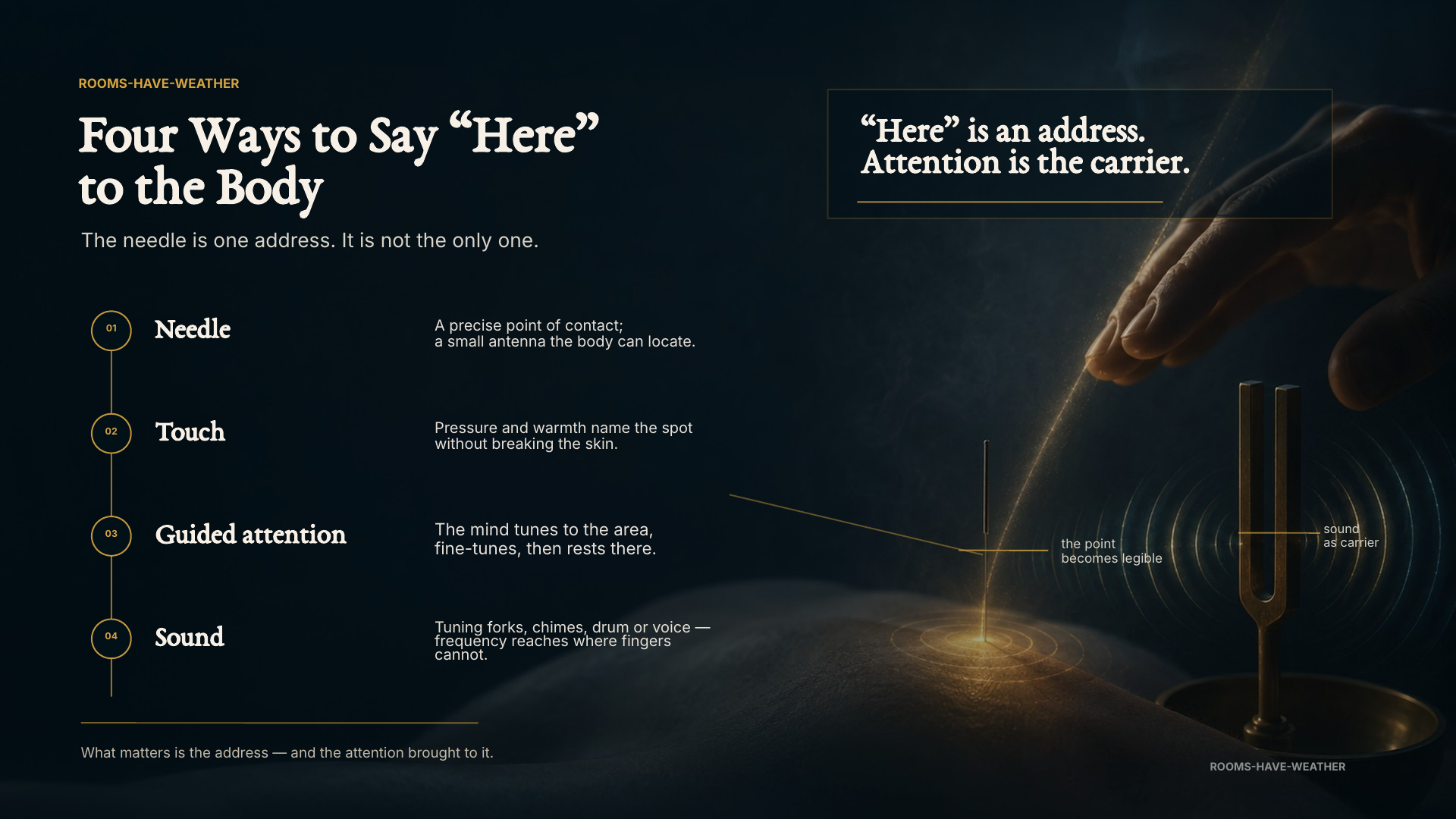
And sound says here, more powerfully than most people expect.
Tuning forks. Chimes. A drum. Specific pieces of music. If you have ever heard chant sung in a church and felt something rise in your chest that you did not put there, you already know sound reaches places fingers cannot. What matters is not the instrument.
It is the address, and the attention you bring to it
A thousand strangers, one intention
🟢 Established Physiology · ⚪ Contested Ground
Which brings us to what an activated coherence does in a group. The measurable part first, because it deserves to be stated plainly: humans synchronise. Choirs align their heart rhythms within minutes of singing together. One crying newborn recruits a nursery. A stadium crowd builds its arousal collectively, each body amplifying the next. A group of humans in a heightened state is not a metaphorical field; it is a measurable one, at least in the bodies composing it. When the drum starts at one of our events, that is the mechanism you can take to the bank: one external rhythm, forty nervous systems, one cohesive field for everyone to be in.
Now the contested part, with its warning label attached.
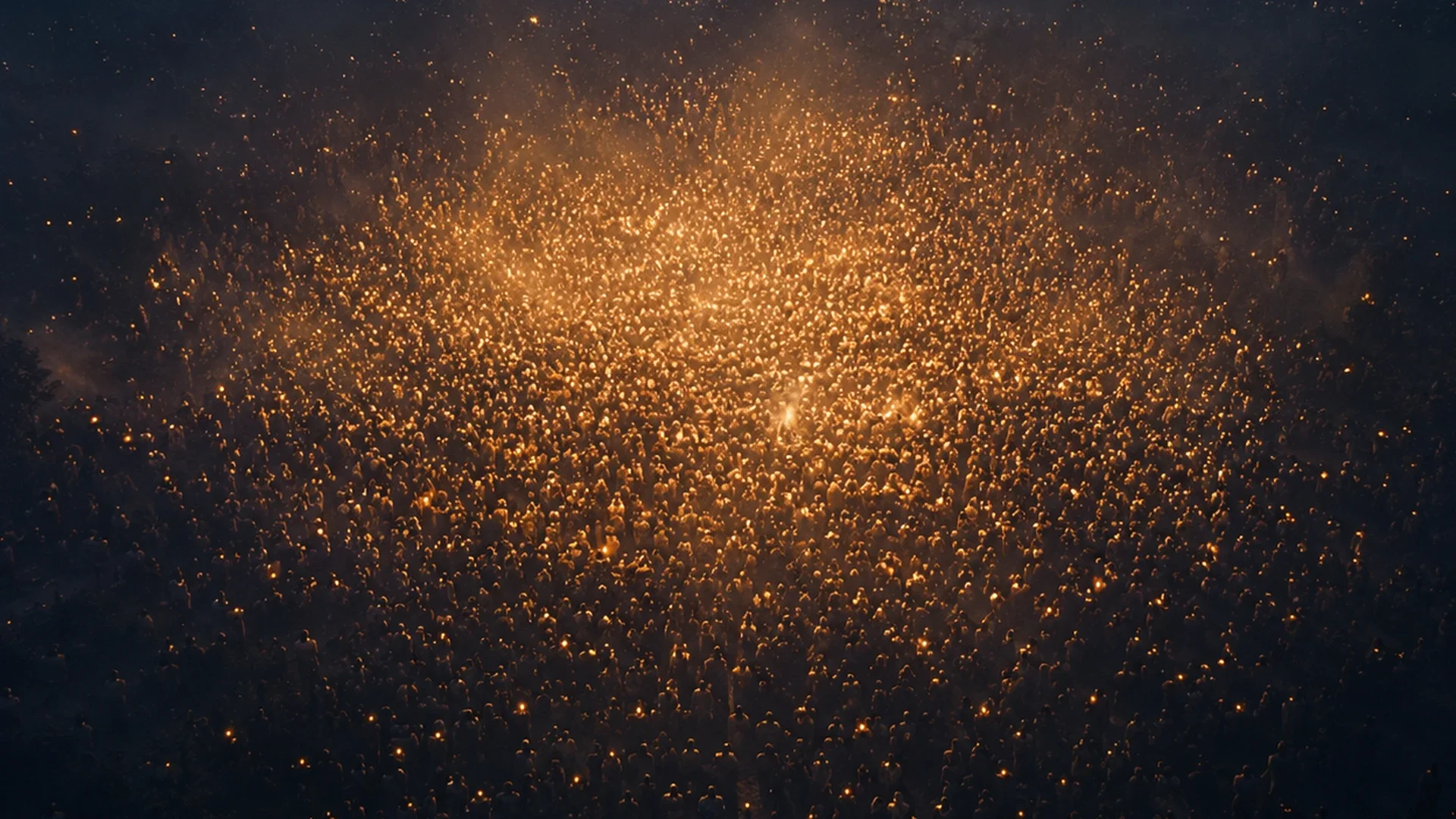
In the Washington DC experiments, a thousand meditators from every tradition gathered to meditate on world peace, and the researchers reported a measurable drop in the city's crime rate while they sat.
I find it fascinating.
I also know the methodology has been argued about ever since, and extraordinary claims need better than argued-about methodology. A hint, not a proof.
But here is what I can vouch for from inside twenty years of group work, and it needs no statistics. When a group works on the same inner territory together, the first person is cutting a path through jungle. Machete out, chopping hard. Everyone who follows walks a clearer trail.
Clip · From the livestream
1,000 People Meditated in Washington DC (Here’s What Was Measured)
A thousand meditators, one city, and a reported drop in crime while they sat. Steven on the study’s contested methodology and the machete principle: why inner work gets easier when a group does it together.
I watch it happen every time two facilitators hold a room. The safety compounds. And safety, the trauma literature agrees, is not a nicety.
It is the precondition.
The window
🟢 Established Physiology · 🔵 Clinical Observation
Someone always wants to know what these sessions actually feel like, and the honest answer sounds more exotic than the mechanism is.
When the geometric patterns are running and the sound comes up, the state that opens is close to the hypnotic one: absorbed, open, suggestible in the technical rather than the sinister sense. A window of opportunity, where deep belief systems can take in genuinely new information. You pass through a lighter version of this window twice a day, the liminal state at the edges of sleep, and hypnosis research has shown for decades that beliefs and habits shift more readily inside it.
What people report from inside is another matter. Spinning geometry. Dreamlike scenes. Memory arriving in full sensory colour. More than one person has told me it was the closest thing to a DMT experience they have had without consuming anything (for readers curious about that overlap, PRISM is doing good work mapping the wider altered-states research landscape), and I pass that on exactly as they say it, with the grounding note attached: the reports resemble what deep hypnagogic states produce anyway, and the visual cortex sits directly behind the very point these sequences dwell on. The exotic, noetic, ineffable and the astonishingly explicable are old friends here.
Clip · From the livestream
The Closest Thing to DMT I’ve Ever Had (Without Taking Anything)
Geometric visualisations, spinning forms, dream-like scenes. What people report from light body activation sessions, and why the state resembles hypnosis.
The imagery is not the point. The window is. And the question worth asking about any window is what comes through it.
What the window is for
🟢 Established Physiology
Trauma gives the clearest answer, so let me walk it through the way I did on the stream.
When an experience overwhelms the system’s capacity to process it, the system does something protective and drastic: it shuts down. The energy compresses and stores for later processing, or is absorbed into the system. Take a blow to the head in a car accident and the impact might not be enough, under other conditions, to knock you out; it is the overwhelm that throws the switch. The body throws the system into a protective shutdown: not necessarily a literal coma, but a neurological retreat from full contact with the experience. And the same shutdown happens with purely psychological events. Clinicians call the milder, lasting form dissociation: a person separated from their own felt experience. It is not weakness, and it is not malfunction. It is a circuit breaker, doing exactly its job.
The cost is that the unprocessed experience doesn’t leave. It gets stored with the circuit still open, which is why trauma has such a long echo, and why it so often resurfaces as body: tension, pattern, the thing that takes on a life of its own.
Clip · From the livestream
Trauma Is the Body’s Own Coma (What Dissociation Actually Is)
When an experience overwhelms the nervous system, it shuts down to protect itself. Steven on dissociation, why traumatic memory gets stuck, and how it resurfaces as tension.
A viewer asked, carefully, whether this work could help someone combating addiction. It can, and I answer that as someone who spent two years working full-time in drug rehabilitation, not as a theory. Gabor Maté has spent a career documenting what those years showed me daily: trauma sits near the root of almost every addiction. Addiction isn’t the problem in isolation: it’s usually a coping strategy, an attempt to solve pain. A person in pain, seeking not to be in pain, along whatever path relieves it fastest. Behind the substance, almost always, the wound. Bring that person into a state that feels whole, held and safe, and the emptiness underneath the pattern is finally given a chance to resolve. From there, moving out of the addiction becomes something closer to natural: change can begin to feel less like moral combat and more like a movement toward wholeness.

And sometimes what comes through the window astonishes me.
More than one cancer patient I've worked with has arrived, entirely in their own time, at gratitude. Not for the suffering; for what the illness forced into the open. What mattered. What didn't. What they wanted the rest of their lives to be. I hold this carefully, because from outside it can sound like a demand that sufferers be thankful, and it is nothing of the kind. Some terrible things are just plainly terrible. Meaning is something a person discovers from the inside; it should never be imposed from the outside. But there is an old saying I have watched come true too many times to dismiss: the biggest dragons hide the most gold.
Clip · From the livestream
Her Response to Cancer Stopped Him (The Biggest Dragons Hide the Most Gold)
A patient who arrived, in her own time, at gratitude, not for the suffering, but for what it forced into the open. Steven on the hidden gifts inside things we’d never choose.
The fine print, said out loud
🔵 Clinical Observation
Near the end of the stream I said the thing I try to say in every room, because it is the most important sentence a practitioner can offer and the one the wellness industry least wants said.
None of this is a magic fix. If you come to one session hoping it will make you give up cigarettes while everything else in your life stays exactly as it was, it almost certainly won’t, and I’ll tell you so before you book. If your life conditions are working against you (housing, violence, isolation), then inner work alone is not enough, and the honest word for what I do is adjunctive: alongside the psychologist, the support worker, the practical help. A perspective shift, even a big one, changes nothing by itself. Return to the same rooms and the same patterns, and the problem will patiently rebuild itself.
What the work gives you is the vantage point and the window. Walking through is not mine to promise.
I’m not going to make your life better. That’s your job.
Clip · From the livestream
I’m Not Going to Make Your Life Better. That’s Your Job.
A healer who makes no promises of healing. If everything else in your life stays the same, nothing will change. Steven’s honest take on what treatment can and cannot do.
What I can offer is what the second walker gets on the jungle path: it has been cut before, the trail holds, and you will not be doing it alone.
The lights go out one by one
By the end of the stream the questions had slowed, the way a room quietens when it has what it came for. We said our goodnights. The little lights left the way they had arrived, one at a time, each one a person somewhere finishing a cup of tea, carrying whatever they were carrying a little differently.
And the thing I noticed, shutting the laptop, is that the weather we had made together outlasted the room. It always does. That is the entire finding, if this piece has one. You read the atmosphere of every space you enter, you have since before you could speak, and you contribute to it whether or not you ever check what you’re broadcasting.
Rooms have weather. And you are part of every forecast.
What would change if you started acting on it?
Full session · The complete livestream
Watch the full conversation
The full live Q&A with Sonic Harmony Sound Healing, including the extended indigo triangle pattern explained point by point.
FREQUENTLY ASKED QUESTIONS
-
A framework connecting the body’s subtle-energy maps (the meridians of Chinese medicine, the chakras, the Kabbalistic tree) into one interconnected network. Practitioners work with it to build clarity, coping capacity and felt-sense awareness.
-
Guided attention moves through a sequence of acupuncture points (no needles required in group settings), supported by sound, breath and intention. Most people enter a deeply relaxed, mildly altered state; many report geometric imagery or dream-like scenes.
-
The threshold state at the edges of sleep, which you pass through twice a day without noticing. Attention loosens, imagery arrives on its own, and hypnosis research has shown for decades that beliefs and habits shift more readily inside it. A Lightbody activation opens a deliberate, held version of the same window.
-
Yes. Points can be activated by touch, guided attention, sound frequencies and gentle electrical stimulation. The needle is one way of marking a location precisely; it is not the only one.
-
It grows out of Esoteric Acupuncture, the system founded by Mikio Sankey; Steven’s transpersonal approach adds deliberate, skilled work with altered states.
-
Studies, including the Washington DC experiments, have claimed measurable drops; their methodology is contested. This article treats the claim as an open question, not a fact.
-
Yes. In Björn Vickhoff’s Frontiers in Psychology study, choir members’ heart rhythms began aligning within minutes of singing together, paced by the shared breath the music demands. It is the cleanest evidence I know that a group of nervous systems becomes, measurably, one field, and it is why our events begin with sound.
-
A protective neurological shutdown that occurs when experience overwhelms the nervous system, described here as the body inducing its own kind of coma. It is the mechanism by which traumatic experience gets stored unprocessed.
-
As an adjunct, yes. Trauma usually sits at the root of addiction, and altered-state work can help it resolve, but life conditions, psychological support and the person’s own participation decide the outcome.
-
That is the argument of his book In the Realm of Hungry Ghosts: the root of addiction is trauma, a person in pain seeking not to be in pain along whatever path relieves it fastest. My two years working full-time in drug rehabilitation showed me the same thing daily. Address the wound and the substance loses much of its job.
-
The main one is deliberate: anything in your life that is out of alignment with the state you cultivate tends to become uncomfortably visible, which is the opportunity to change it.
-
No. The practices function identically whether you treat the maps as energetic reality or as psychological technique.
-
Yes, two ways. I work one-to-one in Byron Bay, and I run group activation events with sound-healing collaborators, which many people find the gentlest way in. Some of the consultative work also travels well by phone or video. Book a session or see upcoming events
NOTES AND REFERENCES
Maté, G. In the Realm of Hungry Ghosts: Close Encounters with Addiction — drgabormate.com
Hagelin, J. et al. (1999). Effects of group practice of the Transcendental Meditation program on preventing violent crime in Washington, D.C. Social Indicators Research — springer.com. Presented here as ⚪ contested; link alongside a methodological critique.
Vickhoff et al. (2013), choir heart-rate synchrony, Frontiers in Psychology — frontiersin.org
Kozlowska et al. (2015), the defence cascade, Harvard Review of Psychiatry — pubmed
Hypnosis and suggestibility — American Psychological Association overview — apa.org/topics/hypnosis
Mikio Sankey — Esoteric Acupuncture, practitioner database — esotericacupuncture.com
PRISM — Psychedelic Research in Science and Medicine (Australia) — prism.org.au (context for the altered-states research landscape)
Sheldrake, R. Science and Spiritual Practices — sheldrake.org