I Couldn’t Climb Stairs. One Acupuncture Session Later, I Touched My Toes.
PROJECT 003 — The Steven Booth Journal
Why good acupuncture is an altered-state technology.
Steven Booth · Transpersonal Acupuncture · Byron Bay
The Five-Second Answer
How does acupuncture actually work?
Through several mechanisms at once, and the needle is only one part of the treatment.
In Chinese medicine, a needle placed at a specific point invites the body's qi to move where it has been blocked or depleted, restoring a flow the tradition has mapped in detail for two thousand years.
Modern research describes overlapping effects in different language: changes in local tissue signalling, circulation and capillary dilation, pain modulation, vagal tone, endorphin and histamine release, activation of immune response, connective-tissue response, activity within the nervous system, and more recently, bioelectrical changes in the fascial tissues.
To me, these are interesting observations, worth having. But even together, they are insufficient to satisfy my curiosity, and inadequate to describe the totality of what happens during treatment.
After my own explorations, personal and professional, I have become most interested in something else: the internal, subjective experience of the patient, and what becomes possible when a treatment changes the state of the person receiving it.

There is a particular kind of pain that makes a staircase look like a mountain. Keep reading to find out how a staircase changed my life’s path.
The Evidence Guide
Throughout this article you'll see ideas drawn from several different traditions of knowledge.
🟢 Established Physiology: Concepts well supported by modern research: physiology, the nervous system and measurable bodily processes.
🟡 Classical Chinese Medicine: Ideas drawn from the classical literature and long-standing clinical practice.
🔵 Clinical Observation: Patterns commonly observed in practice over many years but difficult to isolate in controlled studies.
🟠 Informed Synthesis: Places where modern physiology and Chinese medicine appear to be describing related observations through different conceptual frameworks.
⚪ Contested Ground: Ideas and observations that sit beyond the current consensus, where the evidence is building, the mechanisms are debated, or institutions have not yet caught up with what practitioners are seeing.
In this piece you will find
How acupuncture works, in both the physiological and the Chinese medicine account
Whether acupuncture can really fix back pain, and the one session that redirected a life
Why "Traditional" Chinese Medicine was actually standardised in the 1970s, and what got filtered out
What pulse diagnosis can tell a practitioner that you haven't said out loud
What the five elements are, and how they map to the "parts work" now filling therapy rooms
Why good acupuncture can feel like an altered state, and what that state is for
An honest look at frequency devices and vibrational tools, what's promising, what isn't
What 100 days of one daily practice actually does
This piece covers how acupuncture works in both scientific and Chinese medicine terms, the real history of TCM's standardisation, pulse diagnosis, the five elements as an emotional map, acupuncture's altered states, and what daily practice changes, told through the story of the session that made Steven Booth a practitioner.
A note before we begin. This one comes from the archive. In the winter of 2020, Jacob Gossel had me on his podcast Awake Aware Alive, a long, generous conversation recorded back when I was still living in Melbourne, before Byron Bay, before most of what I now teach had found its current shape and language. Digging it out again was a strange pleasure: it holds more of my origin story than anything I had recorded until then, and the questions Jacob asked are the ones people still ask me every week. The clips through this piece are moments from that conversation, and the full episode sits with Jacob's channel at the end. Thanks, Jacob, you asked them in the right order!
There is a particular kind of pain that makes a staircase look like a mountain.
I met it at twenty. I was halfway through a double degree, advanced math and physics, alongside psychology and philosophy by day, and paying my way by lifting boxes on a loading dock, while the body kept its own quiet ledger of the arrangement. One day the bill came due. My back gave out, and the young man who had been carrying everything couldn't carry himself up a flight of stairs.
I booked an acupuncture session for reasons that were only half rational. My maternal grandfather, was a self-taught bodyworker and acupuncturist back in the '80s, so I had some exposure to the medicine. Still, I had hesitation as I took myself to an acupuncture teaching clinic in Melbourne CBD. It was worth an hour. Nothing else was working.
I walked in barely able to manage stairs. I walked out and touched my toes.
Clip · From the livestream
The session that started everything
He went in barely able to manage stairs and walked out able to touch his toes. Steven tells the story of the treatment that turned a sceptical patient into a practitioner, and why one session was enough to reroute a whole career.
Right, I thought. There's something in this.
Twenty years later, that sentence is still the most honest summary of my career. Not a conversion. Not a vision on the road to anywhere. Just a young man bending forward, surprised by his own hands reaching the floor, with a question following him out the door: what just happened?
This piece is the long answer.
What actually happened
🟢 Established Physiology · 🔵 Clinical Observation
Start with the version you can measure. When a needle enters a point, a small crowd of things happens at once. Local capillaries dilate and blood flow changes. The skin mounts a mild immune response: histamine releases, and different immune cells arrive at the site. The nervous system registers the intrusion and adjusts how it carries sensation. And the brain releases its own opiates: the endorphin shift you feel as that heavy, floating calm partway through a treatment.
None of this is speculative. It is why a physiotherapist with no interest in qi can dry-needle a trigger point and get results, and why acupuncture keeps holding its ground in the chronic pain research, including the large patient-level meta-analyses showing effects beyond placebo for back pain, neck pain and headache. The mechanisms are real. They are also, on their own, an incomplete story.
Because here is what the mechanism list doesn't explain. People don't just report less pain. They report coming back to themselves. Twenty years in, that is the pattern underneath the pattern: something in the state itself, not just the needling, does the deep work.
Hold that thought. We need to go the long way around to earn it.
The common-sense medicine
🟡 Classical Chinese Medicine
Ask me what Chinese medicine actually is and I'll start, unhelpfully, with patterns.
Zoom into the body and the DNA spirals. Zoom out and the galaxy spirals. Between those two scales, everything alive runs on the same waveform: yin flowing into yang and back again, in the swing from night to day, winter to summer, birth to full strength to decline. The medicine is a study of those patterns, and a set of tools for living in harmony with the flow rather than against it.
And underneath the philosophy sits something your grandmother would recognise. Are you sleeping? What are you eating? What is the quality of your thoughts through a day? Who is around you, and how do you fit into the world you're in? That, plus what you arrived with: your constitution, your inheritance, and how the two get along.
The basics of Chinese medicine are common sense. I don't say that as a criticism.
It is the reason the medicine has survived every dynasty, revolution and fashion since it was first written down. The fundamentals keep solving real problems.
The word "traditional" is doing less work than you think
🟡 Classical Chinese Medicine
Now the part most people don't see coming. The system I studied for five years at university, the one taught worldwide as Traditional Chinese Medicine, the TCM on the clinic door, is not, strictly speaking, ancient. It was assembled and standardised in mid-twentieth-century China and documented as a complete, orderly system around the 1970s. A useful, teachable, examinable medicine, with one significant editorial decision baked in: the older medicine's wilder registers (the folklore, the shamanic inheritance, the explicitly spiritual dimensions of practice) were largely filtered out.
What existed before the standardisation was eclectic in the way all living traditions are. Clinical craft braided together with what we in Australia might call bush medicine, with ritual, with spirit. In the universities, qi mostly appears as a polite way of talking about capillary dilation. The reductionist filter earned the medicine its place in the modern academy, and it cost the medicine some of its depth.
Deciphering that space is, if I'm honest, my whole project: take what was filtered out and make it usable, and hearable, for modern people, without dropping the rigour that twenty years of clinical work demands.
Not either/or. The standardised medicine and the older one are both true. What changed is which parts we allowed ourselves to say out loud.
Listening, three ways
🔵 Clinical Observation · 🟢 Established Physiology
So what does the fuller version look like in a treatment room? It starts before the needles. One of the classics says the patient's healing should begin as soon as the first meeting occurs, before any diagnosis, before any herbs. At hello. Modern psychotherapy research agrees from the other direction: across every modality, the quality of the relationship between practitioner and client is one of the strongest predictors of outcome we have. Two maps, one observation.
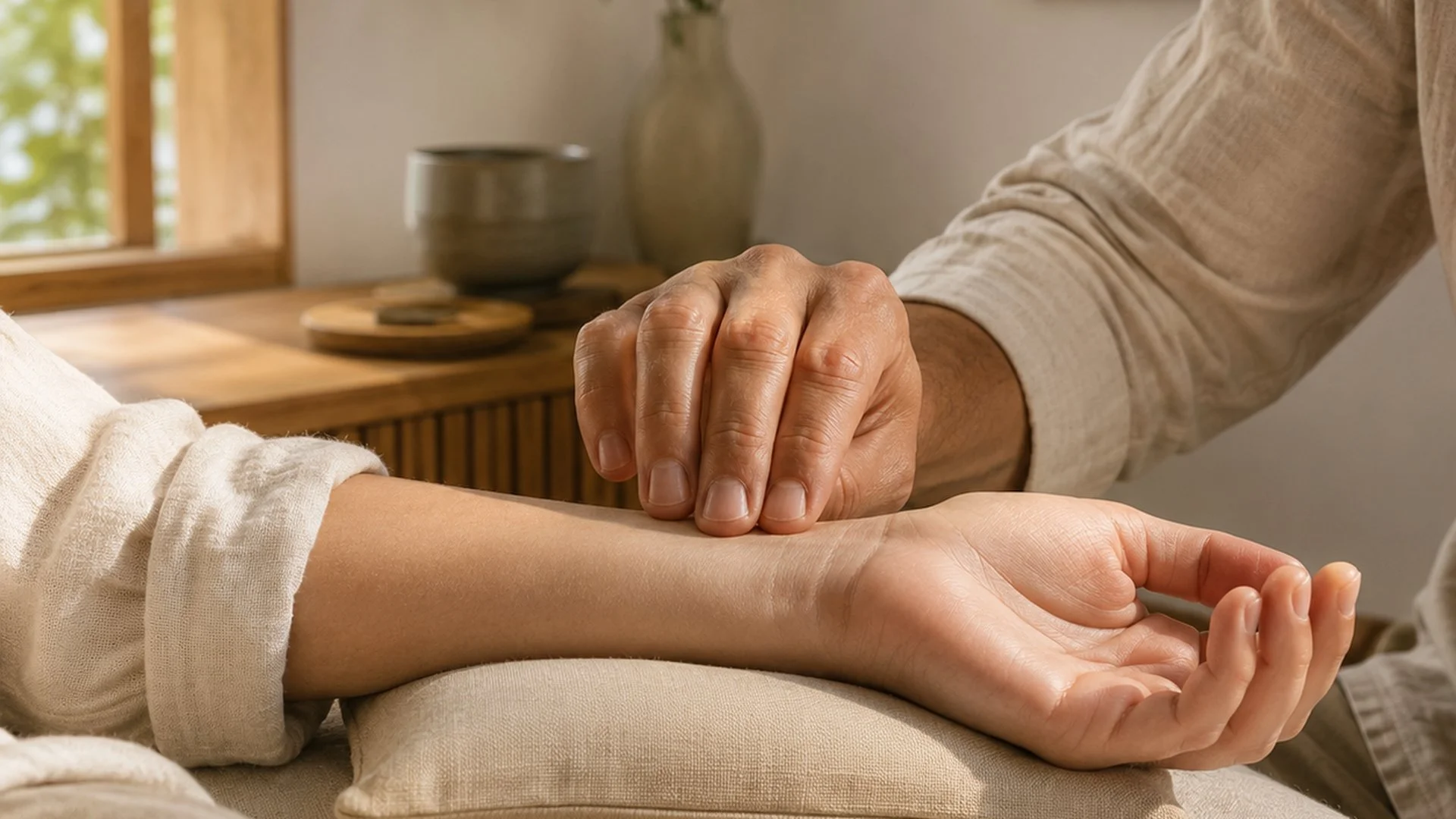
Then the listening begins, and it runs on more channels than conversation. There is the story a person tells me, which may or may not be the true one. There is posture, which rarely lies. And there is pulse diagnosis: in Chinese medicine we don't take the pulse, we listen to it.
You can say you're fine. Your pulse can't.
Clip · From the livestream
You can say you're fine. Your pulse can't.
A person can sit down composed, voice level, everything apparently in order, and the wrist tells a different story. Steven on pulse diagnosis: what a practitioner is listening for, and why the pulse frequently reports what the patient hasn't mentioned.
A person can sit down composed, voice level, everything apparently in order, while the pulse underneath runs bounding and fast: the signature of a system under a pressure the face has decided not to mention. And the practised go much further than I do. I've been to herbalists who could pretty much tell me what I'd had for breakfast from three fingers on a wrist.
You can say you're fine. Your pulse can't.
The points are stories
🟡 Classical Chinese Medicine · 🟠 Informed Synthesis
Every acupuncture point carries a name, a function, and what amounts to a two-thousand-year clinical biography. The point over the centre of the chest is about the heart, and its name tells you so. The point at the crown of the head is the highest place on the physical body; the tradition treats it as the bridge between the human and everything not yet manifest. The point in the centre of each palm is called laogong, "place of work," where we make, break and create.
Clip · From the livestream
The points are stories
Every point has a name, a history and a job: the centre of the palm is laogong, "place of work", where we make, break and create. Steven on why the names are not decoration: they are two thousand years of clinical notes compressed into a map of the body.
Esoteric Acupuncture, the system brought forward by Mikio Sankey that I've spent the last decade working with and extending, begins with a simple move: connect the points, and read the shape. Hold that triangle in guided attention, with needles or without, and the geometry itself starts behaving like a treatment: a structure the mind can inhabit, a story the body can follow.
You can call that sacred geometry, or you can call it a well-designed meditation scaffold. My answer, as usual, is yes and yes.
The five versions of you
🟠 Informed Synthesis
One of the fastest-growing therapy models in the world right now is Internal Family Systems: naming your inner parts (the frustrated you, the sad you, the compassionate you) and letting them speak to each other under the eye of a steadier central self. Therapists' waiting lists fill with it; so do social feeds.
Chinese medicine drew that map about two thousand years early.
Clip · From the livestream
The five versions of you
Wood, fire, earth, metal, water: five organ systems, five temperaments, five versions of you taking turns at the wheel. Steven on the map Chinese medicine drew two thousand years before parts work and Internal Family Systems arrived at the same idea.
The five elements (wood, fire, earth, metal, water) are not just a cosmology. Each pairs with an organ system, and each organ carries its own emotional identity: the rising force and frustration of wood, the joy and connection of fire, the sympathy of earth, the grief of metal, the deep fear and will of water. An internal family, with elemental temperaments. In treatment they can be brought into dialogue, not only in conversation, the way talk therapy does it, but through the body those parts actually live in.
The best five-element practitioners take it somewhere that still delights me. They meet each patient from the element the patient needs. A wood-type wants directness and a bit of authority at the door; approach them with soft sympathy and they'll quietly write you off. An earth-type needs the gentleness that would insult the wood-type. Watch a skilled practitioner shift posture and voice in the first seconds of a consult and you are watching diagnosis and treatment happen before anyone has sat down.
Two maps again. One says parts work. One says wu xing. Both say: you are a committee, and health is the committee talking.
The altered-state technology
🔵 Clinical Observation · 🟠 Informed Synthesis
Now we can come back for the thought I left waiting: what happened in my first session, beyond the mechanics?
My answer, refined over twenty years, is the boldest claim in this piece and the one my clinical experience most insists on. Good acupuncture is an altered-state technology. Usually the state is subtle: the drop into stillness anyone who has had a good treatment knows, the table-warmth, time going soft. Sometimes it is substantial. Occasionally, with skilled work, it approaches the territory people otherwise reach through psychedelics: geometric imagery, dreamscapes, long-buried scenes returning in vivid detail. My own early experiences on the table were exactly that: dreamscapes and visionary places I had no framework for at the time.
Clip · From the livestream
An altered-state technology
Deep relaxation, softened time, sometimes vivid imagery: a good treatment opens a state, and the state is the doorway. Steven on why acupuncture at its best works less like a mechanic and more like a key.
The state is not the point. The state is the doorway. In Chinese medicine the heart is the emperor, and when the heart feels safe and on its own path, the whole system moves into flow. In that flow, the material that has been running your life from the basement (old traumas, protective contractions, the story you installed at seven and never audited) surfaces where it can finally be seen. And things seen from a flow state can be faced in a way they cannot be faced from the state that made them.
The obstacle is the path.
I want to be careful about the edges of this claim, and you should hold me to it. Acupuncture is not a psychedelic, and nobody should book a session expecting the cosmos. The honest version is smaller and more useful: state change is a healing mechanism in its own right, this medicine has always known it, and modern trauma research, with its growing interest in what becomes processable in shifted states, is circling the same observation from the other side.
A doorway I'm still testing
⚪ Contested Ground
Jacob asked me about frequency devices on the podcast, so let me tell you myself rather than have you find it on a forum. Here is the frame that makes sense of it: everything in my treatment room is already frequency. The tuning forks are frequency. The music I choose for a session is frequency. An essential oil is information arriving by smell; a needle is information arriving by touch. A signal generator, a small machine that produces precise waveforms and pulses, is just the literal-minded cousin of the sound healer's toolkit, and the respectable end of it is something every acupuncture student learns: we run electrical pulses through needles for muscle release all the time.
The experimental end is stranger, and I'll be straight about it.
I have run frequency sets through pads on Neiguan, the "inner gate" point on the inner wrist, a point whose whole job, name and all, is to help a person look at what's going on inside. The result was a mild, manageable altered state; nothing like the territory people reach with plant medicine, and I only do that kind of work with people who are interested and fully informed.
Some of it may well be suggestion, which I hold openly: my dad is a GP, and he and plenty of his colleagues will tell you a good share of what they do works partly through exactly that. The forums around these devices attract their share of crackpots alongside the careful people, and some of the claims out there go far beyond anything I'd stand behind, so bring your discernment. It's worth naming why this territory draws so many: in a culture where a growing share of people describe themselves as spiritual but not religious, frequency and vibration are often the first vocabulary people reach for. I don't rely on it on its own, and in my room its readings are at most a prompt (go and get the blood test), never the answer.
A doorway I'm still testing. Not a treatment I'd hang my name on. And never a substitute for care that's known to work.
One hundred days
🔵 Clinical Observation · 🟢 Established Physiology
There is a version of this work that is an event: a session, a breakthrough, a story to tell at dinner. And there is the version that actually changes a life, which is slower and much less glamorous.
When I learned the 37-point meditation sequence that anchors my own practice, I did it every day for one hundred days. Some days it flowed. Some days I zoned out at the same point, day after day, and the zoning out was the information: this is where my attention leaves. The repetition did what repetition does, neurons that fire together wire together, until the sequence began to run itself, and my mind, freed from operating the machinery, started noticing things it had never had the bandwidth to notice.
Clip · From the livestream
One hundred days, one practice
Neurons that fire together wire together: repeat a practice daily and the pathway strengthens until it runs itself. Steven on the hundred-day discipline he learned in his Shiatsu training, and what actually changes when you hold a practice that long.
The same discipline runs through what I ask of practitioners, because I learned it on the Shiatsu mat before I ever held a needle. The first rule of holding space for another body: arrive clear. You cannot relax someone's shoulders while yours are up around your ears; whatever you are carrying comes into the room with you. So the real preparation is not technique. It is your own hundred days: your food, your state, your practice, done before anyone else's healing is attempted.
Small, repeated and real beats big and occasional. In this medicine that is not a slogan. It is the mechanism.
The stairs, again
Which brings me back to a young man at the bottom of a staircase, twenty years old and folded around a back that had given up.
That session did what the mechanism list says: circulation, endorphins, a nervous system talked down from its ledge. It also did what the older, unfiltered medicine says: it restored a flow, and inside that restored flow a life could suddenly move again: up the stairs, out of the freight job, through a Shiatsu diploma and four thousand hours on the mat, a five-year Chinese medicine degree, a transpersonal counselling training I took because people on my table kept having experiences the textbooks hadn't mentioned, and finally out to the strange, rigorous edge of the work where geometry and consciousness meet.
I was raised by atheists and almost became an altar boy. I went looking for answers in physics and philosophy first. What I found, in the end, was less an answer than a direction of travel. And one working rule I'd offer anyone standing where I stood: if you've faced hard things, or your own mortality, and you're looking for an answer you don't have, love is a pretty good answer.
One session. I still bend forward some mornings, hands flat to the floor, and remember when that was a miracle.
The body knew the way up the stairs. It was waiting to be asked properly.
Watch the full conversation
The full 2020 conversation with Jacob Gossel on Awake Aware Alive — Chinese medicine, Esoteric Acupuncture, the internal martial arts and more.
FREQUENTLY ASKED QUESTIONS
-
Needling produces measurable local and systemic effects: capillary and blood-flow changes, a mild immune response, nervous-system signalling shifts and endorphin release. Large patient-level meta-analyses show effects beyond placebo for chronic pain conditions including back pain and headache.
-
Qi is the Chinese medicine term for the body's animating flow: the pattern of circulation, information and vitality that acupuncture aims to unblock. Modern physiology doesn't use the word, but its account of circulation, nervous-system signalling and immune response describes many of the same observable effects.
-
They overlap at the mechanical level: a physiotherapist dry-needling a trigger point is using the same measurable effects (circulation change, immune response, nervous-system signalling) with no interest in qi, and getting results. What acupuncture adds is the map: two thousand years of point locations, functions and combinations, and the state a full treatment opens. Same needle, much larger toolkit.
-
It is one of the best-evidenced uses, and it is how Steven came to the medicine: a back injury that made stairs impossible was moving freely after treatment.
-
TCM is the standardised curriculum assembled in mid-20th-century China and formalised around the 1970s. The older, classical medicine was broader, and included spiritual and folk dimensions that the standardisation filtered out.
-
A diagnostic art in which the practitioner reads qualities of the pulse (speed, depth, force, texture) at several positions on each wrist. It frequently reveals states (agitation, depletion, heat) that the patient hasn't reported.
-
Wood, fire, earth, metal and water: a map linking each organ system to an emotional identity and temperament. It works like an internal family, and it parallels what modern therapy calls parts work or Internal Family Systems.
-
Both map similar territory from different centuries. IFS names inner parts (an angry part, a scared part, a compassionate part) that can be brought into dialogue under a calmer central self. Chinese medicine's five elements, wood, fire, earth, metal, water, assign each organ system its own emotional temperament roughly two thousand years earlier, and clinicians work with them the same way: bringing the parts into conversation rather than suppressing any one of them.
-
Commonly a mild one: deep relaxation and a softened sense of time. With skilled work the state can be more pronounced, including vivid imagery. In transpersonal practice that state is treated as therapeutic in itself: material surfaces there that ordinary states keep buried.
-
Often, yes, though not as a replacement for trauma therapy. Chinese medicine treats the altered state a good treatment opens as therapeutic in its own right: material that's been running in the background can surface where it's finally visible. Modern trauma research, with its growing interest in what becomes processable in shifted states, is exploring similar territory from another direction.
-
A standard technique every acupuncture student learns: a gentle electrical pulse run between needles, most commonly for muscle release and stubborn pain. It sits at the respectable, well-travelled end of the frequency conversation: one more way of delivering information to a point.
-
Frequency devices are small machines that generate precise electrical waveforms, an extension of standard electroacupuncture. The well-established end (running current through needles for muscle release) is taught in every acupuncture program. The experimental end, using signal generators on specific points to shift state, is genuinely contested ground: promising in clinical observation, not yet backed by controlled research, and worth approaching with real discernment.
-
A system developed by Mikio Sankey that sequences acupuncture points into geometric patterns for meditation and treatment, aimed at consciousness development as much as symptom relief. Steven's transpersonal approach builds on it.
-
No. The physiological effects occur regardless of belief, and clinical trials aren’t run on believers only. Belief shapes expectation, as it does in all medicine, but the maps work whether you read them as energy or as physiology.
-
It is the popular shorthand for Donald Hebb’s 1949 principle of how the brain learns: repeat an experience and the pathway carrying it strengthens until it runs itself. That is why one hundred days of a daily practice changes what the mind can do, and why a week of raised shoulders becomes a posture. Repetition is neutral. It compounds whatever you give it.
-
Yes. I see patients one-to-one in Byron Bay, and new patients get a longer first visit so there is time for a proper history before any needles. If you are not local, guidance is also available by phone or video.
NOTES AND REFERENCES
1. Vickers, A.J. et al. (2018). Acupuncture for chronic pain: update of an individual patient data meta-analysis. The Journal of Pain: pubmed.ncbi.nlm.nih.gov/29198932
2. NCCIH: Acupuncture: effectiveness and safety: nccih.nih.gov/health/acupuncture
3. Taylor, K. (2005). Chinese Medicine in Early Communist China, 1945–63: A Medicine of Revolution: routledge.com
4. Flückiger, C. et al. (2018). The alliance in adult psychotherapy: a meta-analytic synthesis. Psychotherapy: pubmed.ncbi.nlm.nih.gov/29792475
5. IFS Institute: the Internal Family Systems model: ifs-institute.com
6. Hebb, D.O. (1949). The Organization of Behavior: origin of "neurons that fire together wire together" (no public URL available)
7. Sankey, M.: Esoteric Acupuncture: esotericacupuncture.com
8. Pew Research Center: Religious Landscape Study: pewresearch.org