The Cosmic IP Address
PROJECT 004 — The Steven Booth Journal
Why the body stores not the event, but the posture you took toward it.
Steven Booth · Transpersonal Acupuncture · Byron Bay
The Five-Second Answer
What is transpersonal acupuncture?
It is acupuncture that works with more than the physical body. It opens a doorway into the deeper patterns beneath symptoms: the felt postures, memories, beliefs and protective reflexes the body has learned to hold. Alongside the needles, a practitioner may use attention, sound, breath, guided meditation and feeling-state work to help a person view their own patterns from a wider perspective, sometimes in a gently altered state of consciousness. The needle opens the door; the shift in state and meaning is where the deeper work happens. Search the term and you will find almost nobody using it. Here is what it looks like from inside the treatment room.
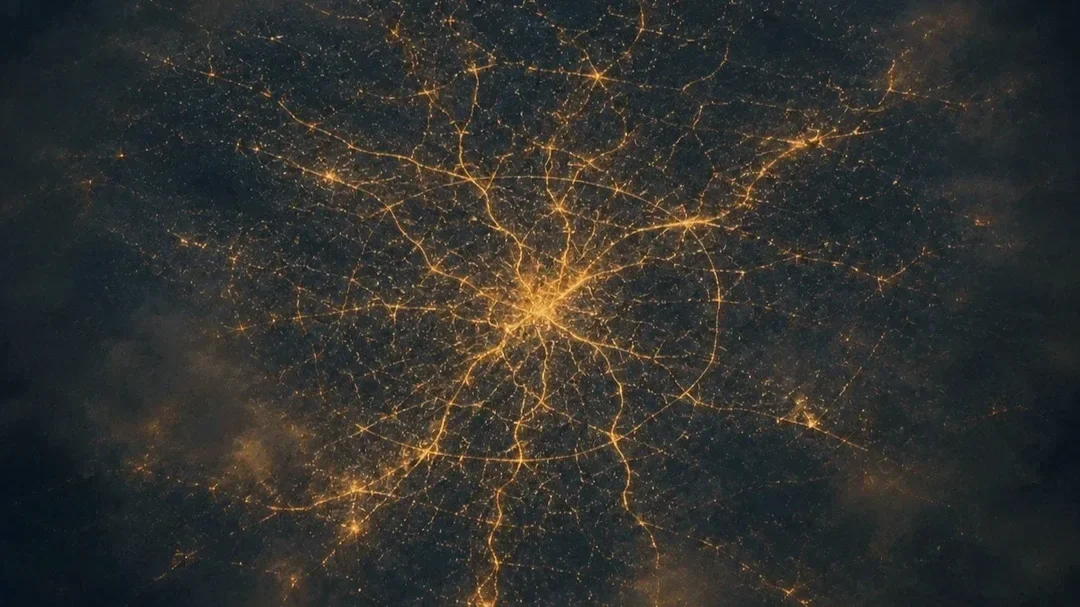
THE COSMIC IP ADDRESS
A NODE IN THE FIELD OF SPACE TIME
The Evidence Guide
Throughout this article you'll see ideas drawn from several different traditions of knowledge.
🟢 Established Physiology — Concepts well supported by modern research — physiology, the nervous system and measurable bodily processes.
🟡 Classical Chinese Medicine — Ideas drawn from the classical literature and long-standing clinical practice.
🔵 Clinical Observation — Patterns commonly observed in practice over many years but difficult to isolate in controlled studies.
🟠 Informed Synthesis — Places where modern physiology and Chinese medicine appear to be describing related observations through different conceptual frameworks.
⚪ Contested Ground — Ideas and observations that sit beyond the current consensus, where the evidence is building, the mechanisms are debated, or institutions have not yet caught up with what practitioners are seeing.
In this piece you will find
What transpersonal acupuncture actually is, and how it differs from ordinary acupuncture
Where anxiety is felt in the body, and why everyone can point to it
What Chinese medicine means by spirit, and how a practitioner sees someone gaining or losing it
Whether you can have a psychedelic-like experience without taking anything
What the Johns Hopkins psilocybin research shows about spiritual experience and lasting change
The acupressure point for anxiety you are probably already gripping
Why being grateful for chronic pain sounds cruel, and why it sometimes works anyway
A practice that takes two minutes, and where to find a practitioner
A note before we begin. Earlier this year I sat down with my good friend Ben Cleaver for his podcast, Everybody Knows. Ben and I met at a retreat some years back, and he has a gift for asking the questions most interviewers are too polite to ask, including whether mushrooms are going to put me out of business. This entry in the Journal grew out of that conversation. The short clips through the piece are moments from the episode, and the full conversation sits at the end for anyone who prefers to listen. Thanks, mate.
There is an example I use with patients because everyone recognises it instantly. Someone cuts you off in traffic. Your shoulders go up. It is the oldest reflex there is: protect the neck, brace for impact. The impact never comes. The other driver disappears down the highway. The whole event is over in four seconds.
A week later, your shoulders still haven’t come down.
Clip · From the livestream
Why Are Your Shoulders So Tight? Your Body Is Storing It
Someone cuts you off in traffic and your shoulders jump. That part is sensible; that part is the body doing its job. What is stranger is that a week later they still have not dropped. Steven on the ledger the body keeps without asking you, and why the posture outlasts the moment that made it.
Nobody decides to keep their shoulders up. There is no moment where you weigh the options and choose sustained trapezius contraction. It simply never gets switched off. And if the next week brings another driver, a difficult email, a tense conversation, the posture gets reinforced, because the body answers each of them the way it answered the first. Protect the neck. Brace for impact. Over time the bracing stops being something you do and becomes something you are. It settles into the way you walk, the way you hold yourself, the set of your jaw.
The body doesn't store events. It stores the posture you took toward them. It carries forward the shape each event required.
Hold that thought, because the rest of this piece is about a stranger and more hopeful idea hiding inside it. If the bad afternoons leave a forwarding address in your body, so do the good ones.
And an address is something you can visit.
That is what I mean by a cosmic IP address: not a mystical coordinate floating somewhere else, but a precise felt location in your own movement through space-time, one the entangled body can still recognise in resonance.
Ordinary acupuncture does not need any of this language to work. A well-trained practitioner can treat pain, digestion, sleep, stress and countless other presentations with the classical tools alone. Transpersonal acupuncture is not a replacement for that; it is an extension. It asks what the symptom is connected to in the person’s lived experience, and whether the treatment room can become a place where that pattern is felt, understood and reorganised.
Where is it?
🔵 Clinical Observation
The deeper I have gone into this work, the less I think healing is primarily about removing symptoms. It seems increasingly concerned with organisation. Anxiety, grief, trauma and chronic pain each leave the body organised around a particular relationship to the world. Safety reorganises it. Love reorganises it. Perspective reorganises it. The tools differ. The underlying movement is remarkably consistent.
When someone comes into my clinic with anxiety, one of my first questions is: where is it? When you get anxious, where is it in your body? Can you point to it?
Everyone can. Even when it's vague. It's in my chest. It feels like this, then this happens, then this. People don't describe anxiety as an abstraction. They describe it as a sequence with a location, and they can put it on the map of their body without hesitating. Which tells you something before treatment has even begun.
Daoist medicine and Eastern thought describe the whole person as a single unit: the "bodymind". The mind and body were never operating separately. We just fell into the habit of describing them that way.
Clip · From the livestream
Where do you feel anxiety?
Not "why are you anxious," which invites a story, but "where do you feel it," which invites a fact. In twenty years of asking, Steven has never met a patient who could not point to the spot: the chest, the throat, the pit of the stomach. Anxiety always has an address, and the address is information.
What the instruments see
🟢 Established Physiology
None of this is mystical yet. Everything we've discussed so far sits comfortably within established physiology. Any emotional change is reflected in physiology, and we can watch it happen. Heart rate changes. Brain activity changes. Breath patterns change, and so do the quality and tensions within the breath. Heart rate variability, one of the better-studied markers we have, shifts with emotional state reliably enough to be used as a clinical measure.
The research on what makes therapy work points in the same direction, away from technique and toward relationship. The humanistic tradition, following Carl Rogers, identified the therapeutic alliance as one of the most reliable predictors of outcome. That alliance is the heart-centred rapport between practitioner and patient, the felt sense of being met, understood and safe. It matters more than any particular method or technique. Anyone can put needles in someone. If you're trained, you'll usually get a beneficial response: histamine release, endorphins, the chemistry of relief. But the connection is the active ingredient the studies keep finding when they go looking for what actually helps.
One of the Chinese medicine classics says the same thing elegantly. 上工治未病 Shàng gōng zhì wèi bìng — (Su Wen). The superior physician has done much of the healing by the time the introductions are over, because the person already feels met, confident, safe.
Twenty-five centuries apart. Two traditions. One finding.
The wind and the sand dunes
🟡 Classical Chinese Medicine
Chinese medicine has a word for what modern medicine struggles to talk about at all: Shen, usually translated as "Spirit". It has another for the unseen energies themselves: Feng, or "Wind". Both are invisible in themselves, yet visible through their effects. I can see the trees moving outside my window, but I am not watching the wind. I am watching the tree. A sand dune is a 3D printout of wind movements over time, but nobody has ever seen the wind.

Unless there’s sand in it.
The esoteric world (literally "hidden") is the same: you can't see thoughts or ideas, but you can see their effects. A person's beliefs and understandings show up in their behaviour, their actions, and eventually their health, the way wind shows up in a dune.
The classics are practical about this. When assessing prognosis, one of the questions is simply: does this person have shen? And there are clear things to look for. Are the eyes shiny? Is there brightness in the demeanour? Is the person managing the changes that are upon them? In fact, rather than asking does this person have shen?, we ask in terms of active function: are they gaining shen, or losing it?
You can meet someone quiet and physically frail who still has a sparkle in the eye, and someone in far better shape who is already defeated, dull, broken on the inside. The first is gaining spirit. The second is losing it.
Any experienced clinician of any tradition has seen both. The vocabulary is the only thing that differs.
Clip · From the livestream
What Chinese medicine means by "spirit"
You have never seen the wind. You have seen a tree bending and a dune that has quietly changed shape overnight, and from those you infer it without difficulty. Steven on shen (the word usually translated as spirit) and how a clinician reads it not as a mystical claim but in the way a person carries themselves into a room.
The view from altitude
🟢 Established Physiology · 🟠 Informed Synthesis
Can you have a psychedelic-like experience without taking anything? The honest answer is that you already do, in miniature, all the time. Consciousness operates on a spectrum, and you travel it daily. Roughly a third of your life is spent in an altered state; it's called sleep, and nobody finds it alarming. A frightening film is an altered state: heart racing, hormones shifting, and nothing physically happening to you at all. Runners get there. So do people singing in churches.
Clip · From the livestream
You already alter your consciousness
A horror film races your heart while nothing whatsoever is happening to your body. A song you have not heard since you were nineteen puts you back in that kitchen. Steven on the altered states you slip into most weeks without meaning to, and why the word sounds exotic only because we reserve it for the ones we choose on purpose.
At the far end of the spectrum sit the big states: deep contemplative absorption, breakthrough experiences, the territory the psychedelic researchers are now mapping. What they share is altitude. Problems that looked insoluble from ground level often reorganise themselves once consciousness climbs high enough to see the whole landscape. People see their own history from a wider vantage point, the way a city only makes sense when you stop standing in the laneway and climb high enough to see the freeways, the arterials, the shape of the whole. That is roughly what the word transpersonal means: getting far enough outside your own story to see it, and then coming back.
It's worth naming plainly, then, what the work built on that word actually is. Transpersonal Acupuncture encompasses Esoteric Acupuncture, and the transpersonal part is exactly this deliberate, skilled use of altitude: alongside the needles I work with attention, feeling states, sound and guided meditation to help you see your own patterns from higher up, and then bring what you saw back down with you. The needling is the doorway. The change of vantage is the medicine.
Striking evidence comes from Johns Hopkins, where psilocybin has been studied as therapy for end-of-life anxiety in people with terminal illness. Participants consistently rank the experience among the most meaningful of their lives, and the research keeps finding the same odd detail: when the experience has a spiritual quality, the benefit is larger and lasts longer. In the PTSD trials run by MAPS and its collaborators, some participants improved so much after the first round that they no longer met criteria for the study. The best possible outcome, and a confounding nightmare, at the same time. Australia has its own chapter in this research: PRISM, Psychedelic Research in Science and Medicine, a sister organisation to MAPS, spent years building the foundations for therapeutic trials here, including the Melbourne end-of-life work.
Clip · From the livestream
Does psychedelic therapy work for PTSD?
The trials keep running into a problem that most research would envy: participants get well enough after a single session that they no longer meet the criteria to stay in the study. Steven on what the psilocybin and MDMA work is actually showing, where the evidence is strong, where it is still thin, and why the state the medicine opens may matter more than the molecule.
Ben asked me, reasonably, whether the mushrooms are going to put me out of business.
The therapeutic psychedelic protocols rest on set, setting and substance: why you're doing it, where you're doing it, what you're taking. I'd add a fourth. Skill. What do you do when your awareness expands and the new information floods in? How do you centre yourself, process it, make sense of it afterwards? That skill can be developed without any substance at all, and developing it is much of my work.
The switches the body already knows
🟢 Established Physiology · 🟡 Classical Chinese Medicine
On my table the tools are quieter. Sound, tuning forks, guided meditation, breath. The needles themselves, with their cascade of endorphins and their shift of the nervous system out of fight-for-life and into rest-and-repair.
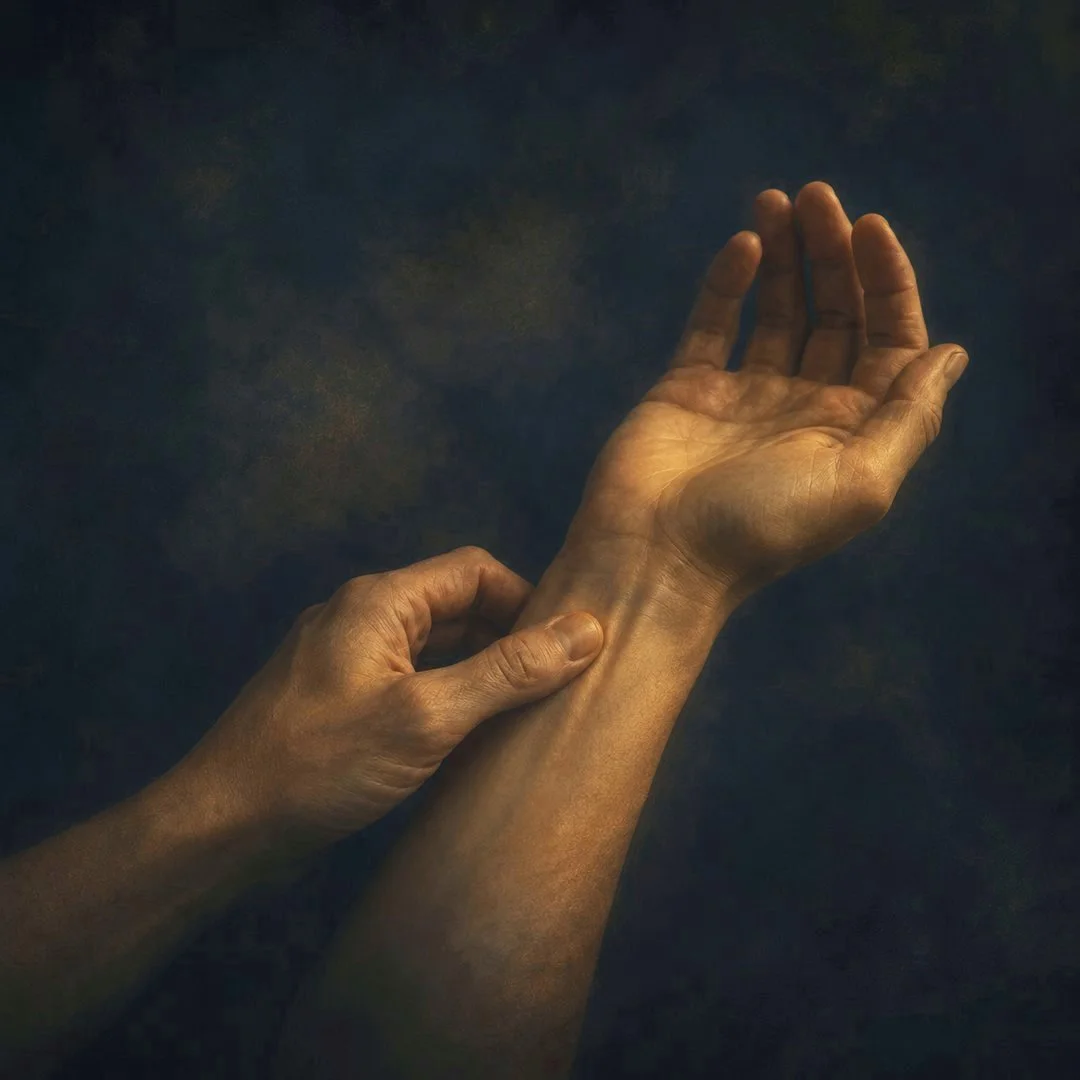
And there is a point on the inner wrist the Chinese called Neiguan (the inner gate), sitting over the median nerve, in a region known clinically for its effects on nausea, autonomic regulation and the felt centre of the chest, with an indirect relationship to the vagus nerve.
Watch an anxious person and you'll often see them gripping exactly that spot, without ever having heard of it. The pharmacy sells motion-sickness wristbands that press it; the evidence for that use is solid enough to have been reviewed by Cochrane. In the dim-mak ("death-point striking") arts of Baguazhang and Taijiquan, we strike or grasp this same point to drain or disrupt energy, to set up a stronger follow-up strike, or, again, to reach the centre line indirectly.
The body has always known where its own switches are.
People come back from these sessions with recounts that would sound strange in a GP's office. Symbols. Spinning geometry. A grandmother twenty years gone who had something to say. What matters clinically is not the imagery. It's what changes afterwards: a sense of agency, the discovery through experience that you have the power to change how you feel. And a shift in values, where the things that seemed worth all that effort quietly lose their grip, and closeness and connection move up the list.
Clip · From the livestream
The point that calms the vagus nerve
There is a point on the inner wrist that anxious people find on their own, gripping it without being taught, and it is the same one the travel-sickness bands press. Steven on Neiguan: what the classical texts said it was for, what the vagus nerve research says now, and how often those two accounts turn out to be describing the same thing from different directions.
The address
🟠 Informed Synthesis · ⚪ Contested Ground
Now the part of my work that raises eyebrows, and the phrase this journal entry is named for.
Think of a moment when you felt completely safe. Not safety as a concept: a particular moment anchored in space and time. There was a time, a place, a temperature, a quality of light, particular people nearby or a particular silence. Your body recorded all of it, the same way it recorded the traffic. That moment has what I call a cosmic IP address: a location in your history specific enough that you can dial it up. Recall the physical sensations first, because they're stored in your matter and they feel most real. Start with the body. The pressure of the chair. The warmth of the air. The light through the window. The smell of the room. The people beside you.
You can do this process to tune in to any remembered resonant frequency — so pick something beneficial to work with. Try with one of your peak experiences of Heart frequencies: love in its many forms, a moment of connection, something in nature, wonder, awe, gratitude, compassion. Find something that bubbles to the surface for you, in the now, and make a bridge between this moment, and that remembered moment. Dial in enough of the data points and the feeling itself arrives, in the body, in the present tense.

Not remembered. Re-entered.
That is the raw material. The geometry is how we keep it from evaporating: a structured container. Connect any three points and you have a triangle: a stable shape to hold a resonant frequency. In treatment we build feeling states this way: safety, protection, compassion, recalled from real memories in full sensory detail, then anchored to locations in the body in stable arrangements.
[insert heart frequency tuning-in meditation here — build task]
Over the back of the neck and shoulder blades, a diamond, filled deliberately with the felt sense of being protected, in precisely the place where the body has spent years rehearsing defence.
The traffic laid a pattern into your shoulders without asking. You can use the techniques derived from Esoteric Acupuncture to re-encode these patterns, soften that armouring, and replace it with an expansion and unfolding of the Heart energy. In this expansion, the contraction and armouring can not co-exist. I invite you to try it for yourself, and offer your field the opportunity to recalibrate and entrain a more beneficial default state of being. If you find it useful, please check out the courses on lightwork.academy to go deeper.
Whether you call the result an energetic map or a psychological one may not matter much. Memory, felt sense and location are three things the nervous system demonstrably works with. We are arranging them deliberately and consciously, rather than by default or random configuration.
I'll name the reach before someone names it for me: there are quantum-gravity researchers who argue the basic unit of space-time is itself geometric, and some, particularly in the HeartMath orbit, report the heart's electromagnetic field as significantly stronger and more measurable at a distance than the brain's. Contested ground, all of it, and I hold it with curiosity rather than certainty. The clinical practice doesn't stand or fall on any of it.
The reason we anchor to the heart is simpler. When the mind rests in the heart space, compassion, gratitude and benevolence are the easiest things to reach. If you have the capacity to focus your time and attention on anything, then why not choose love as a good place to start, provided it includes clarity, boundaries and truth. It initiates a beneficial vector, at the very least.
You can't really go wrong.
Clip · From the livestream
Why healers start with the heart
It is more practical than mystical. The heart is simply the easiest place in the body to reach compassion from, the shortest route to the feeling, and whatever you cultivate there recolours how you meet the next person who walks in. Steven on why nearly every tradition begins in the same place, and why that convergence is worth taking seriously.
Ben asked me near the end what love actually is, which is a large question for a Tuesday. The best I could offer is the same answer I gave for spirit: you know it by how it shows up. I won’t let my ten-month-old eat a chocolate bar. From his point of view this is plainly unloving. Boundaries, structure, telling someone a clear and uncomfortable thing: all of these can be love, depending on the altitude you view them from. Watch the actions. The feeling you’ll recognise when you’re on the receiving end of it.
And once you’ve felt it, you know one more address.
Gratitude for the thing you'd never have chosen
🔵 Clinical Observation
Chronic pain runs on a loop. The pain makes you feel terrible. Feeling terrible changes your perception of the pain, which now feels worse, which makes you feel more terrible. Anyone who has lived inside that spiral knows how airtight it is, like depression's fog, where no exit is visible because the fog is doing the looking.
You cannot think your way out of a loop you are standing inside. But if treatment can interrupt it, even briefly, even as simple respite, everything gets easier. And from inside a state that feels safe and held, something becomes possible that sounds almost offensive from outside: looking at the trauma, or the pain, with something like gratitude.
Clip · From the livestream
Chronic Pain and Mental Health: The Loop They Get Stuck In
Pain makes you feel worse. Feeling worse makes the pain feel worse still. Round it goes, and from inside the loop it is almost impossible to see that it is a loop at all. Steven on the pattern every chronic-pain sufferer knows in their body long before anyone names it for them, and the one place a treatment can reach in and interrupt it.
I want to be careful here, and I'll say the part I most want to say out loud: some terrible things are just terrible. Gratitude does not rewrite history. It changes your relationship with it. Gratitude doesn't mean the thing was okay, and it's not something a practitioner should prescribe over someone else's wound. It means you have found the place where the experience yielded something: wisdom you would not otherwise have, a direction you would not have taken. From that vantage the pattern can be reprocessed rather than merely endured. Far easier to say than to do.
Also, in my experience, where some of the deepest healing happens.
There is more science gathering around gratitude than most people expect. Rupert Sheldrake devotes a chapter of Science and Spiritual Practices to the research on gratitude as a practice. One of the landmark studies in this field came from psychologists Robert Emmons and Michael McCullough, who asked participants to keep brief weekly records of either things they were grateful for, hassles they had experienced, or neutral life events. Those who practised gratitude reported better subjective wellbeing than the comparison groups. Later reviews and meta-analyses have found the same broad pattern: gratitude practices tend to produce small, meaningful improvements in mood and mental wellbeing, especially when practised consistently rather than performed as a vague positive-thinking exercise.
The conclusion: practised gratitude changes measurable outcomes, from sleep to mood to cardiovascular markers. That matters here because gratitude is not being used as a slogan. It is being used as a state-change practice. When a person can feel gratitude in the body (slowly, honestly, without pretending the painful thing was good), they are no longer standing in exactly the same relationship to the wound. Something has moved. The nervous system has found another address.
What to actually do
🔵 Clinical Observation
The homework is unglamorous. Find what inspires you and follow it. The things that make it worth getting up in the morning are data about your higher values; make sure some part of your life is pointed at them.
Support that with small practices. Two minutes of gratitude in the morning, felt in the body rather than recited in the head, is a fine way to program a day. It does not need to be an hour of sitting cross-legged. People tell me they can’t exercise because they can’t schedule two hours at the gym. Skip for one minute. Walk for ten and breathe. I knew a man who went from six beers a night to four and his whole life changed, medication reduced and all. Small change compounds, exactly the way the raised shoulders compounded.
Just in the other direction.
The two-minute coherence address practice
Choose one moment when you felt genuinely safe, loved, protected or clear.
Recall the body sensations first. Where did your shoulders sit? What happened in your breath? What changed in your chest, belly or jaw?
Add the room: light, temperature, sound, people, smell, distance, colour.
Let the feeling arrive rather than forcing it.
Place one hand where the feeling is strongest and stay for ten breaths.
If you want a practitioner working in this territory: look for qualification, look for experience, and above all look for someone with whom you feel safe, because on the table you are stripped down, vulnerable, and about to be poked with bits of metal, and the classics and the psychotherapy research agree that the relationship is most of the medicine. Keep going until you find one. Mikio Sankey’s Esoteric Acupuncture site keeps a database of trained practitioners, and my own teaching platform, Lightwork Academy, is opening with entry-level courses for exactly the person who wants to begin.
The shoulders, again

Someone will cut you off in traffic this week.
Your shoulders will go up, because that reflex is ancient and correct and not yours to veto. Later, in the quiet, there is the usual question, worth asking with your attention in your body rather than on this page: did they come down?
And underneath it, the stranger question this journal entry has been circling the whole time.
Can you remember, precisely, in your body, the last time they did? The place, the light, the company, the temperature of the air?
Because that moment has an address.
And now you know how to dial.
Work with this directly
If this way of working speaks to you, there are three ways in:
• One-to-one transpersonal acupuncture in Byron Bay — for people wanting table work, body-based pattern change and deeper integration.
• Phone or video consults — for the reflective and integrative side of the work, especially where distance is an issue.
• Lightwork Academy courses — for students and practitioners who want to learn the maps, practices and foundations.
Full episode · The complete conversation
Watch the full conversation
Prefer to listen? The full conversation with Ben Cleaver covers all of this and more, including the alien encounters.
FREQUENTLY ASKED QUESTIONS
-
Acupuncture that works with more than the physical body. Alongside needling, the practitioner uses guided meditation, sound, breath and feeling-state work to help a person see and change their own patterns from a shifted perspective, sometimes in a gently altered state of consciousness. The term includes Steven Booth's development of the Esoteric Acupuncture toolkit, incorporating deliberate work with altered states.
-
You lie on the table and a shared intention for the session is agreed. Alongside the needles, the practitioner may use sound (tuning forks, chimes, specific music), guided meditation directing your attention to particular points, breath work, and gentle electrical stimulation of points such as Neiguan on the inner wrist. Many people enter a deeply relaxed, dream-like state; afterwards, the session closes with integration of whatever arose.
-
Yes, mildly and safely. Needling triggers endorphin release, blood-vessel dilation and a shift of the nervous system toward rest-and-repair. A sense of heart-brain coherence can develop. Combined with sound and guided meditation, many patients report dream-like states: imagery, memories arriving in sensory detail, and experiences resembling the hypnagogic states at the edge of sleep.
-
My term for how the body stores felt experience: every moment of real safety or love in your history has an address specific enough to dial up, made of place, light, temperature and company. Recall enough of those data points, physical sensations first, and the feeling arrives in the body in the present tense. Not remembered; re-entered. That state is the raw material Transpersonal Acupuncture works with.
-
Most people can point to a specific place, commonly the chest, and describe a repeating physical sequence: this tightens, then this happens, then this. That felt location is not incidental; it is used directly in treatment, and it reflects the measurable fact that every emotional change shows up in heart rate, breath and muscle tension.
-
Usually translated as spirit, shen describes a person's brightness, adaptability and vitality: the 'sparkle in the eye' a practitioner assesses for prognosis. Chinese medicine has a separate word for the unseen energies themselves, feng, or wind: something you cannot see directly, but whose effects are visible in behaviour, demeanour and health, the way wind is visible in a sand dune.
-
Neiguan (“the inner gate”) sits on the inner wrist over the median nerve, which connects to signalling that indirectly reaches the vagus nerve. Classically it is used for the heart centre, anxiety and nausea. The acupressure wristbands sold in pharmacies for motion sickness press this same point, an application reviewed by Cochrane.
-
Researchers at the HeartMath Institute report the heart's electromagnetic field as significantly stronger, and more measurable at a distance, than the brain's. The reason we anchor to the heart is simpler; when the mind rests there, compassion and benevolence are the easiest things to reach.
-
In registered clinical trials with terminal-illness patients, guided psilocybin sessions produced large, lasting reductions in end-of-life anxiety, with participants ranking the experience among the most meaningful of their lives. The research consistently finds that when the experience has a spiritual quality, the benefit is stronger and lasts longer. Australia’s own research groundwork has been laid by PRISM (Psychedelic Research in Science & Medicine).
-
Esoteric means what is hidden, as opposed to exoteric, what is obvious. Esoteric Acupuncture, founded by Japanese-American acupuncturist Mikio Sankey, works with what sits beneath the surface: ideas, value systems, energetics and deliberate change, through vectored geometric point sequences. It usually carries a spiritual dimension, working with the finer frequencies of the heart field.
-
Carl Rogers and the humanistic tradition identified the therapeutic alliance, the honest, heart-centred rapport between practitioner and patient, as mattering more to the outcome than any particular method, and the research has kept confirming it since. One of the Chinese medicine classics agrees: the superior physician has done much of the healing by the time the introductions are over. Twenty-five centuries apart, one finding.
-
Look for qualification, look for experience, and above all look for someone with whom you feel safe; the classics and the psychotherapy research agree the relationship is most of the medicine. Mikio Sankey’s esotericacupuncture.com lists trained practitioners worldwide; Steven Booth practises in Byron Bay, Australia, and his Lightwork Academy offers entry-level courses.
-
Yes. It is the heart of my one-to-one practice in Byron Bay. The hands-on table work is in person; the reflective, integrative and teaching components can also work by phone or video. Book or enquire here.
NOTES AND REFERENCES
Rogers, C.R. (1957). The necessary and sufficient conditions of therapeutic personality change. Journal of Consulting Psychology → psycnet.apa.org
Griffiths, R.R. et al. (2016). Psilocybin produces substantial and sustained decreases in depression and anxiety in patients with life-threatening cancer. Journal of Psychopharmacology → journals.sagepub.com
MAPS, Multidisciplinary Association for Psychedelic Studies, PTSD trial programme → maps.org
PRISM, Psychedelic Research in Science and Medicine (Australia), sister organisation to MAPS → prism.org.au
Cochrane Review: Stimulation of the wrist acupuncture point PC6 for preventing postoperative nausea and vomiting →cochranelibrary.com
HeartMath Institute research library (heart electromagnetic field measurements; presented in this piece as contested ground) → heartmath.org/research
Sheldrake, R. (2017). Science and Spiritual Practices→ sheldrake.org
Emmons, R.A. & McCullough, M.E. (2003). Counting blessings versus burdens: An experimental investigation of gratitude and subjective well-being in daily life. Journal of Personality and Social Psychology, 84(2), 377–389 → pubmed.ncbi.nlm.nih.gov
Diniz, G. et al. (2023). The effects of gratitude interventions: a systematic review and meta-analysis. Einstein (São Paulo), 21, eRW0371 → pubmed.ncbi.nlm.nih.gov
Mikio Sankey, Esoteric Acupuncture, practitioner database → esotericacupuncture.com
Additional gratitude reference cited in the body: Andrew Huberman, “The Science of Gratitude & How to Build a Gratitude Practice,” Huberman Lab →hubermanlab.com