Get your feet off the cold floor!
PROJECT 001 — The Steven Booth Journal
Why your body thinks warmth means safety
Steven Booth · Transpersonal Acupuncture · Byron Bay
The Five-Second Answer
Should you wear socks on cold floors?
Probably, yes.
Chinese medicine has advised people to protect the soles of their feet from cold for more than two thousand years. It describes the feet as the entrance to the Kidney channel: the system responsible for our deepest reserves of warmth, vitality and resilience.
Modern physiology uses different language, yet it points toward some surprisingly similar observations. Cold feet influence circulation, sleep onset and how the nervous system regulates heat. Hard flooring also removes warmth from the body much faster than soft flooring, even when both surfaces are exactly the same temperature.
Whether you think in terms of Kidney Yang or thermal regulation, the practical advice turns out to be remarkably similar.
Sometimes the oldest habits survive because they continue to solve real problems.
Evidence Guide
Throughout this article you'll see ideas drawn from several different traditions of knowledge.
🟢 Established Physiology Concepts well supported by modern research, including heat transfer, thermoregulation, circulation and sleep physiology.
🟡 Classical Chinese Medicine Ideas drawn from the classical literature and long-standing clinical practice.
🔵 Clinical Observation Patterns commonly observed in practice over many years but difficult to isolate in controlled studies.
🟠 Informed Synthesis Places where modern physiology and Chinese medicine appear to be describing related observations through different conceptual frameworks.
In this article you'll find
Why tile floors feel colder than timber or carpet even when they're the same temperature
Why Chinese medicine pays so much attention to the soles of the feet
Why keeping your feet warm may influence sleep, period pain and overall vitality
The curious science behind socks and orgasm
Why protecting your Yang is often less about dramatic interventions and more about ordinary daily habits
This article covers what Chinese medicine understands about cold feet, why they matter more than most people assume, what they indicate about deeper patterns in the body, and what to do about them.

Every morning begins with a conversation your body is already having.
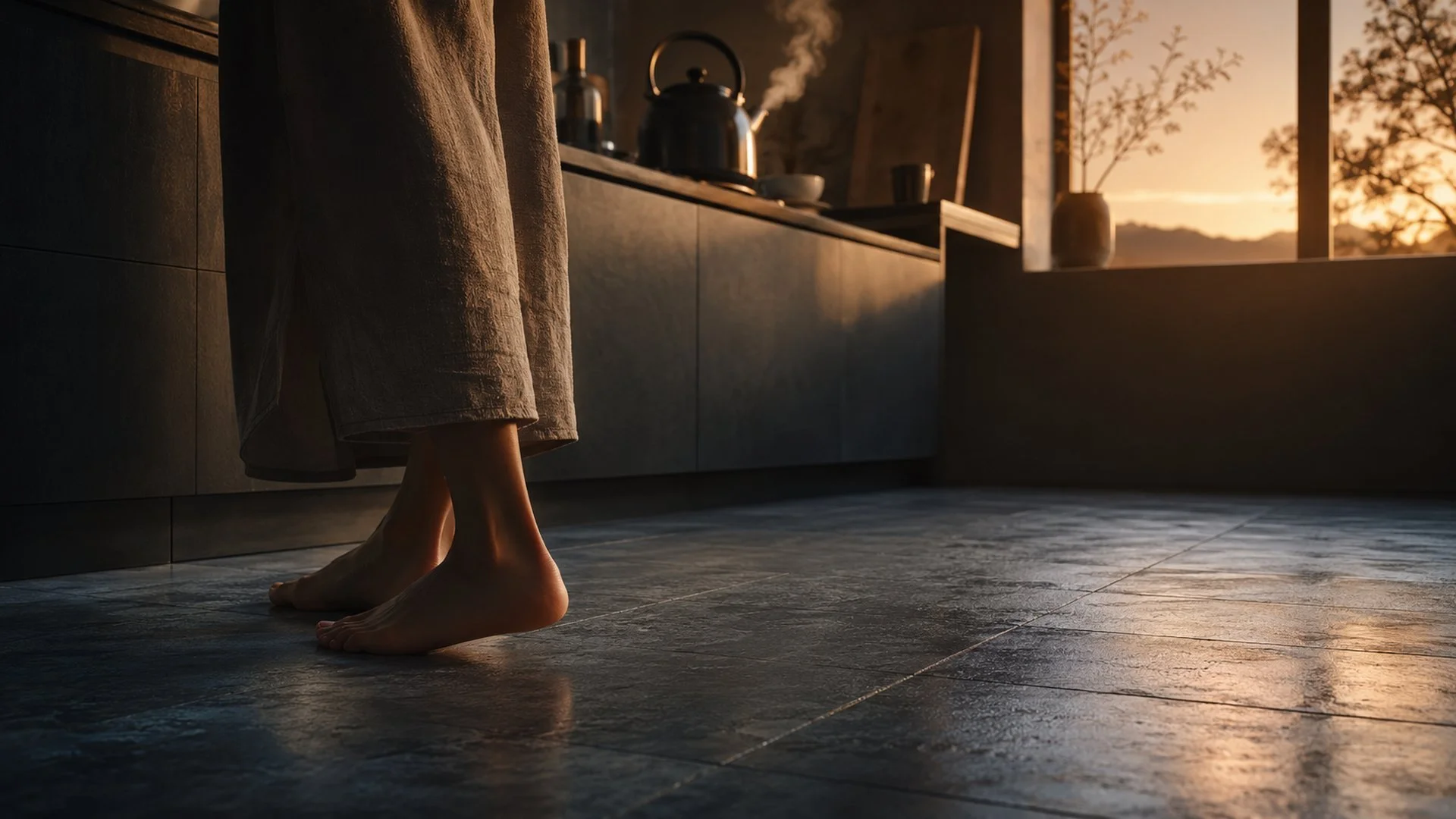
There is a particular hour,
usually before anyone else is awake, when you pad out to the kitchen barefoot and the tiles meet your soles like a small electric shock. You wince, you fill the kettle, you carry on.
Most of my patients have stopped noticing this. They mention the insomnia. The flat afternoons. The periods that arrive like a fist. Not the cold floor.
In Chinese medicine, the sole of your foot is not the far end of you. It is where something begins.
The floor isn't colder. It empties you faster.
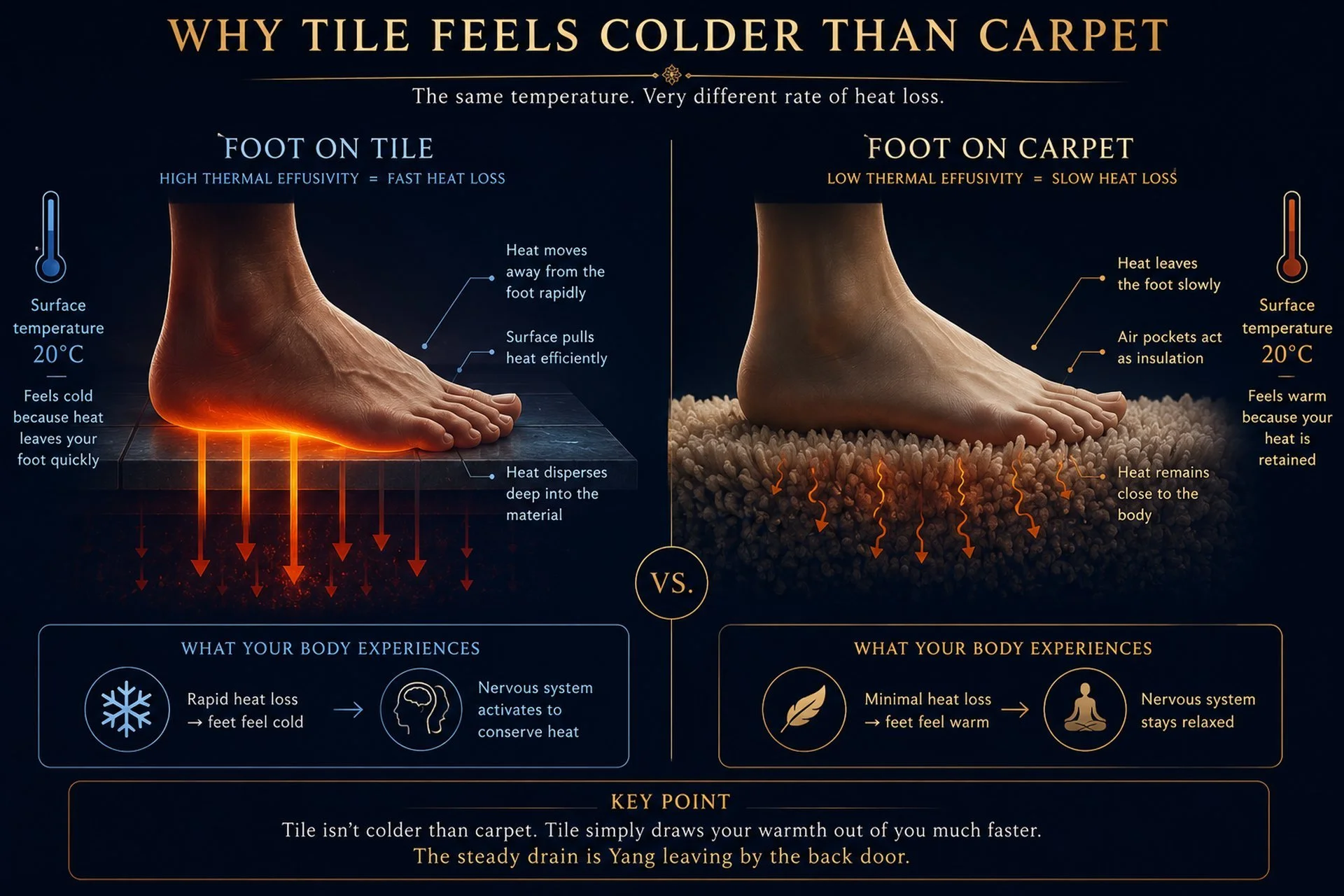
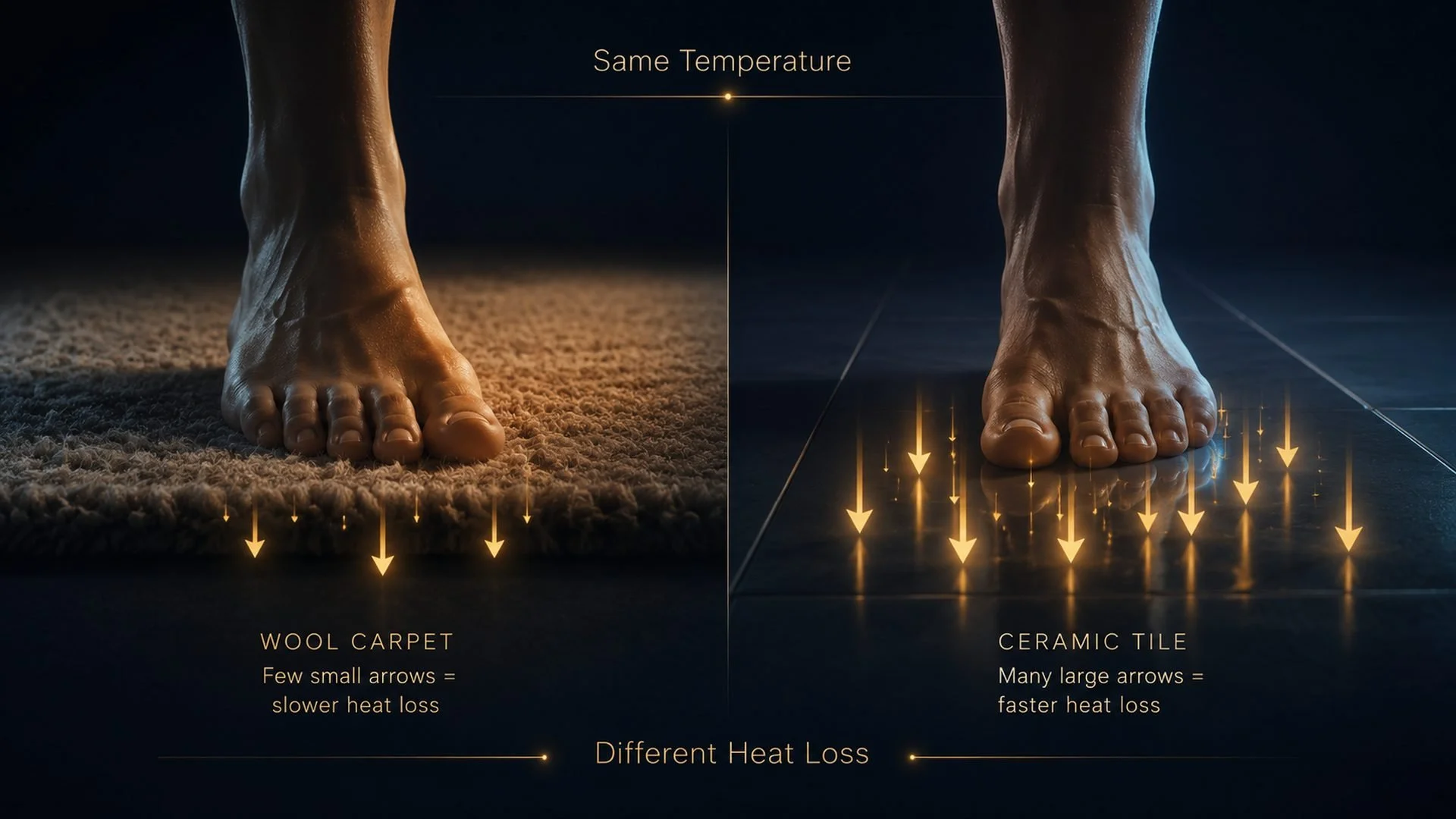
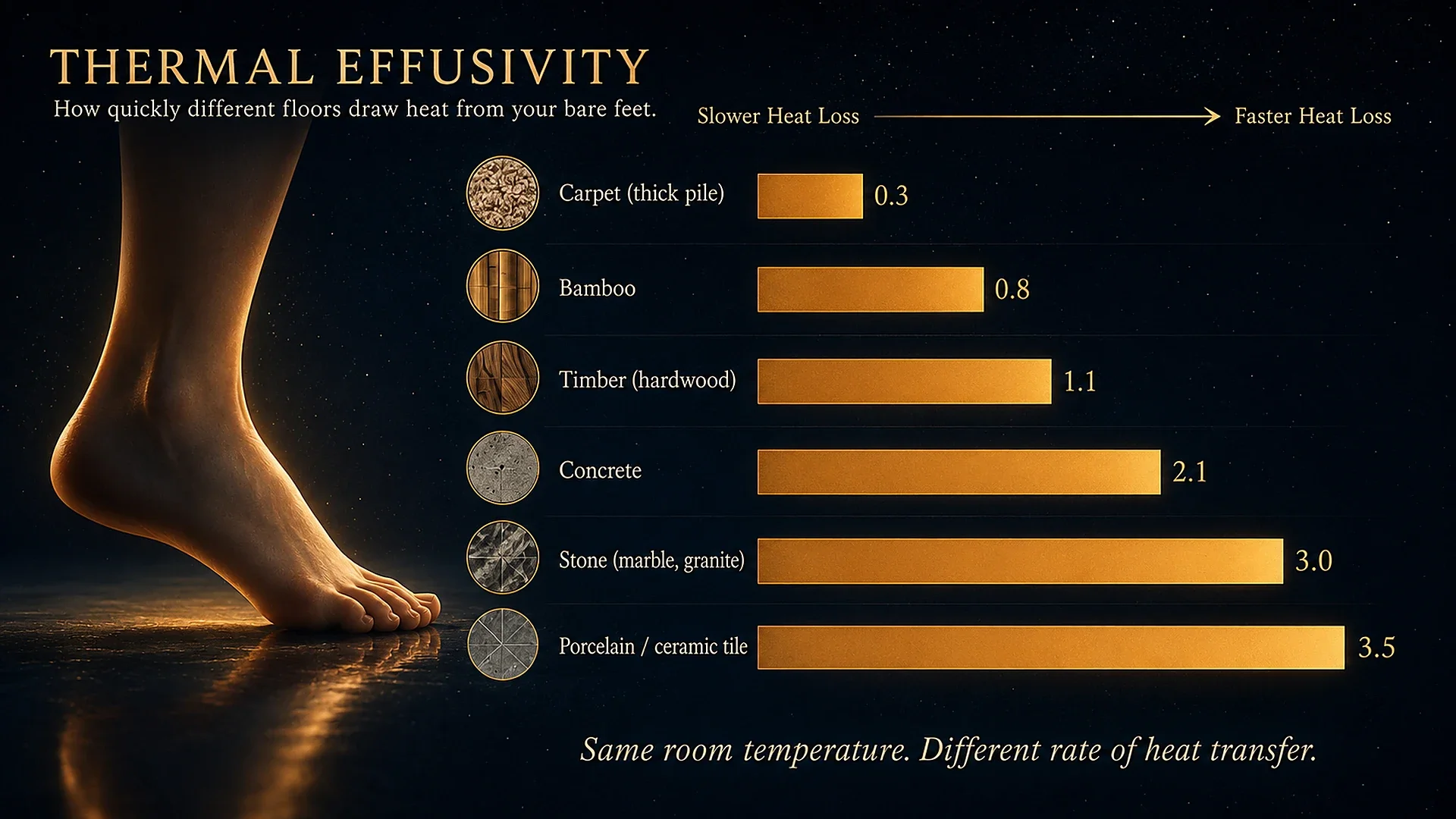
A tile floor and a wool rug sitting in the same room are almost always exactly the same temperature.
Read that again.
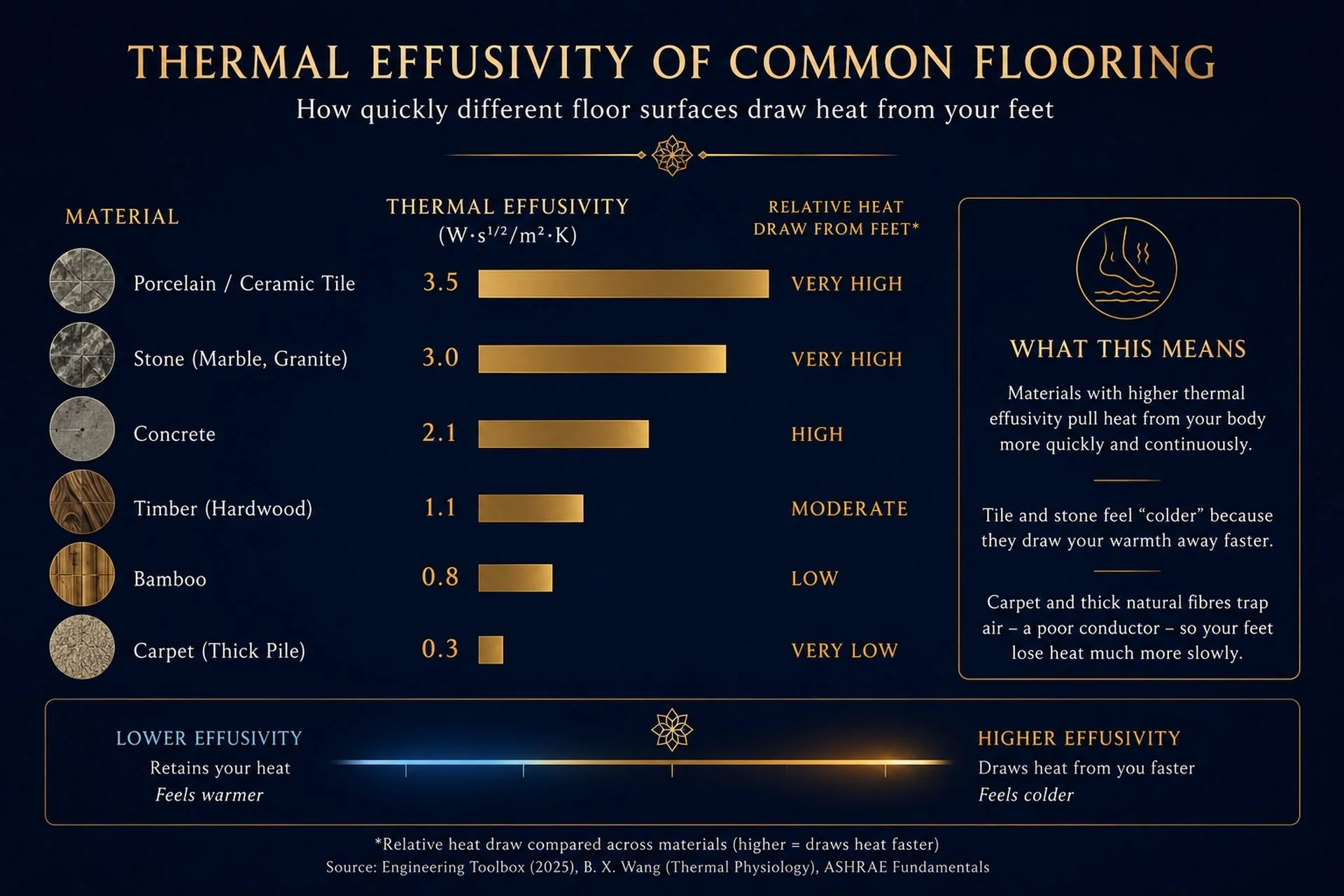
The tile is not colder. It only feels colder, because what your nervous system is actually measuring is not the temperature of the surface, but how quickly heat leaves your body. Dense materials like ceramic tile, stone and concrete are exceptionally efficient at drawing warmth away from your skin. Wood does it more slowly. Carpet slower still, because its fibres trap pockets of air, and air is one of nature's poorest conductors of heat.
Your foot on cold tile is not resting on something colder. It is resting on something that empties it faster. That steady, unremarkable drain is Yang leaving by the back door.
It starts at the sole
🟡 Classical Chinese Medicine
The sole of the foot is richly supplied with blood vessels, sensory nerves and thermoreceptors. Chinese physicians noticed something else thousands of years ago: when this region repeatedly becomes cold, people often develop a remarkably consistent pattern of symptoms.
The Kidney channel rises
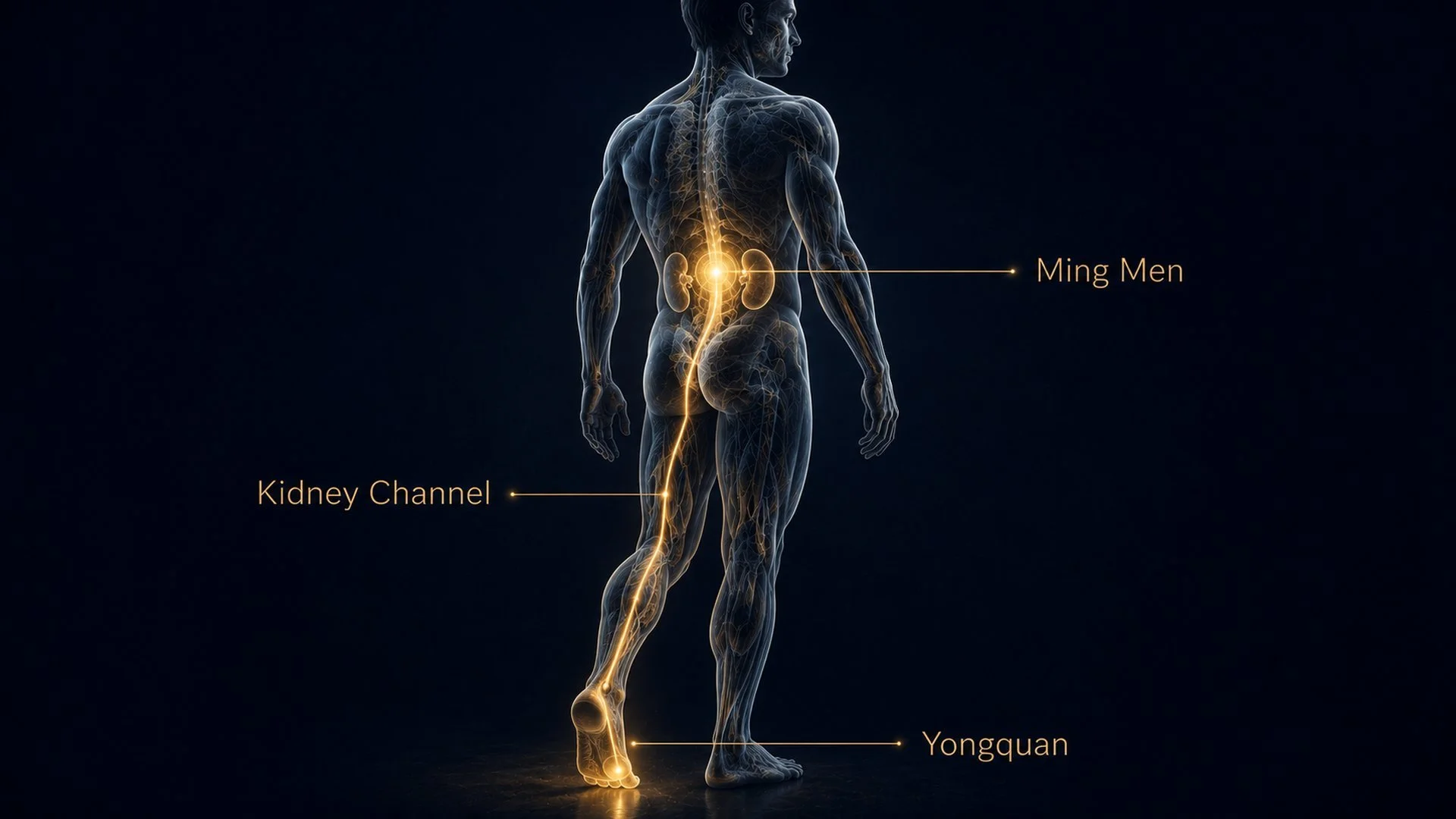
from a point on the sole called Yongquan, Bubbling Spring, where your deepest reserves well up from the earth. Of all the places to leave open to the cold, the underside of the foot is the worst. It opens straight onto the channel that governs your constitutional fire.
Bare feet on cold tile are not a grandmother's fuss. That is cold entering at the root.
Cold, in this medicine, is not just an absence of warmth. It has a personality, and its personality is contraction. The old clinical line is: cold congeals, warmth moves. After enough years in clinic, “Cold congeals” stops sounding mystical and starts sounding like trying to pump honey through a garden hose on a winter morning.
This isn't a fringe position. The Shang Han Lun, one of Chinese medicine's founding texts, is devoted entirely to how cold injures the body in stages, beginning at the surface and travelling inward if it isn't met there. The deepest stage reaches the level of Heart and Kidney: cold limbs, a person who wants only to curl up and sleep, a pulse gone faint and deep. The formula for that depth is still on the shelf, eighteen centuries later. Medicine is surprisingly Darwinian. Bad ideas disappear. Treatments that consistently fail are forgotten. The Shang Han Lun has remained clinically relevant for nearly eighteen centuries because generation after generation of physicians continued finding that its observations worked in front of real patients.
Watch · Steven on the basics
What Is Chinese Medicine? The 90-Second Answer
The short version, before the detail. Steven on what the medicine is actually doing when it treats something as ordinary as cold feet.
Blood is meant to move like water in a well-run system. Cold turns it sluggish at the edges, thickened in the smaller vessels. Where blood stops moving cleanly you get everything that follows from stagnation: aching, stiffness, that bone-deep chill a jumper somehow never fixes.
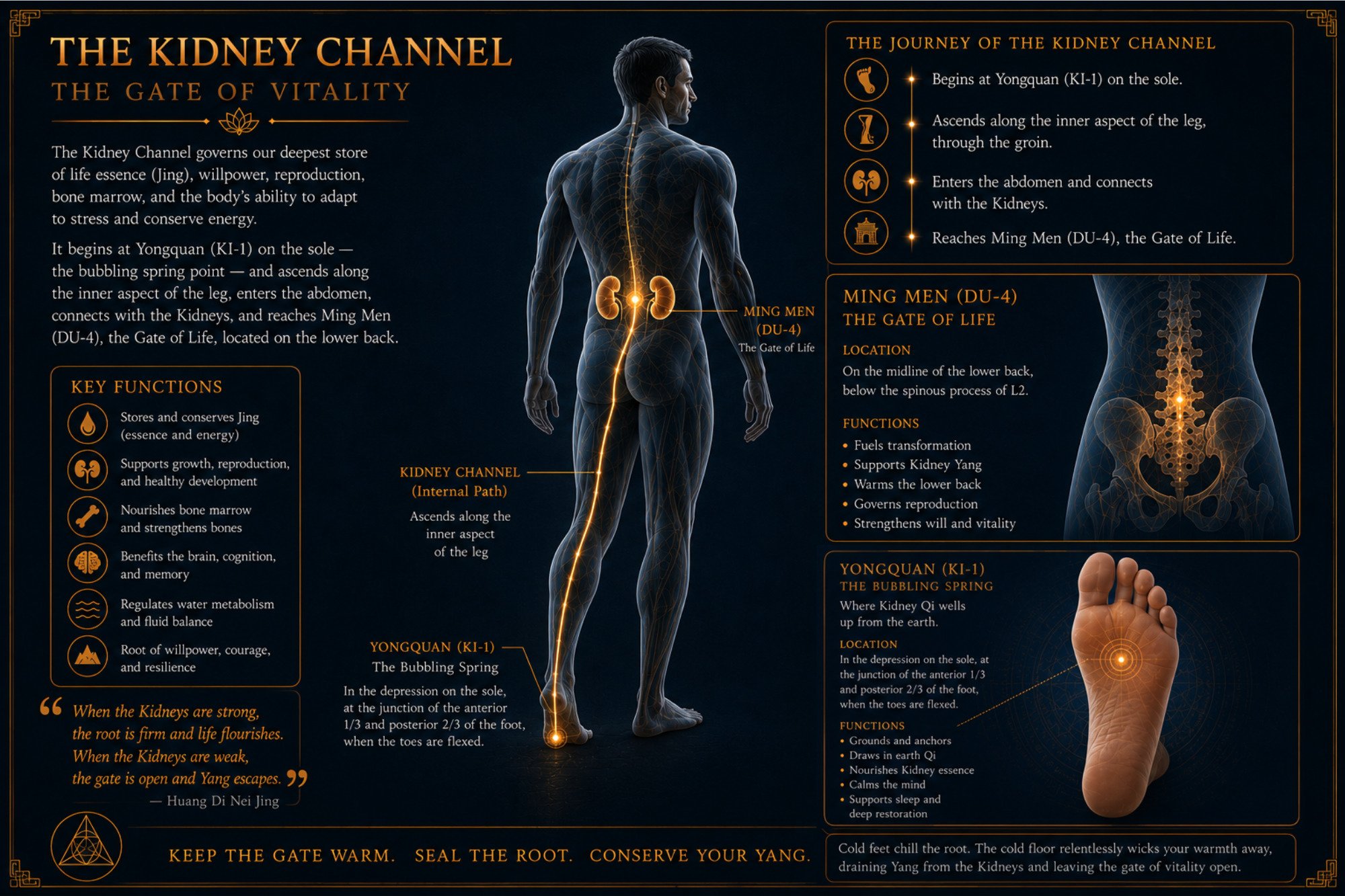
The Kidney channel begins at Yongquan on the sole and ascends to Ming Men, the Gate of Vitality, at the lower back.
Cold, blood and the lower abdomen
🟡 Classical Chinese Medicine · 🔵 Clinical Observation
Here I'll speak particularly to the women reading this.
The three Yin channels of the leg, Kidney, Liver, and Spleen, all run up the inner ankle and inside the leg, and they all have a relationship with the uterus and the movement of blood through the pelvis. When cold travels up through cold feet and a cold lower body, classical theory says it settles in the lower burner. The picture that produces in the clinic is specific and recognisable.
Period pain that is sharp and cramping rather than dull. Blood that arrives dark or clotted. A cycle that comes late. Deep relief the moment a hot water bottle goes on the belly.
None of that is exotic. Most women already know intuitively that warmth on the lower abdomen helps and cold makes it worse. The medicine is just naming the mechanism, and asking you to take it seriously before the cramp arrives, not during it.
This is also why, across almost every traditional culture, the period right after birth carries the same instruction in different accents: keep the new mother warm, keep her off cold floors, cover her feet, no cold water. The postpartum window is a moment of real depletion, of Blood and of what I'm about to describe, and the traditions weren't being fussy or superstitious. They were protecting an internal fire that had just done something momentous.
The Pilot Light
🟡 Classical Chinese Medicine
Underneath all of this sits the concept worth understanding: Kidney Yang, the Ming Men, the Gate of Vitality.
Think of it as your pilot light. Every other organ in the body borrows its warmth from it. It is what lets you transform food into energy, hold your temperature, meet the morning with some actual spark rather than dragging yourself through it, and yes, feel any desire at all.
The thing about a pilot light is that it is small. It doesn't respond well to repeated little gusts of cold over years. One frozen morning won't undo you. A decade of frozen mornings, layered onto a constitution already running lean, is a different conversation. And it usually announces itself quietly: cold hands and feet that have become just how you are, a flat mid-afternoon you've accepted as normal, a bed you can never quite warm up in.
More than that, it is the access gateway to your deepest energy reserves and inner resources, your Will, and survival impulses. Your vitality, longevity, and health span are all centrally dependent on this spark of life.
Protecting your Yang is not dramatic. It is mostly the unglamorous discipline of not handing your warmth away for free.
And yes, the socks question
🟠 Informed Synthesis
I get asked this more than you'd think, usually with a raised eyebrow.
The story: researchers at the University of Groningen were scanning volunteers mid-orgasm. Only about half could finish inside the machine until they handed out socks, at which point eighty percent could
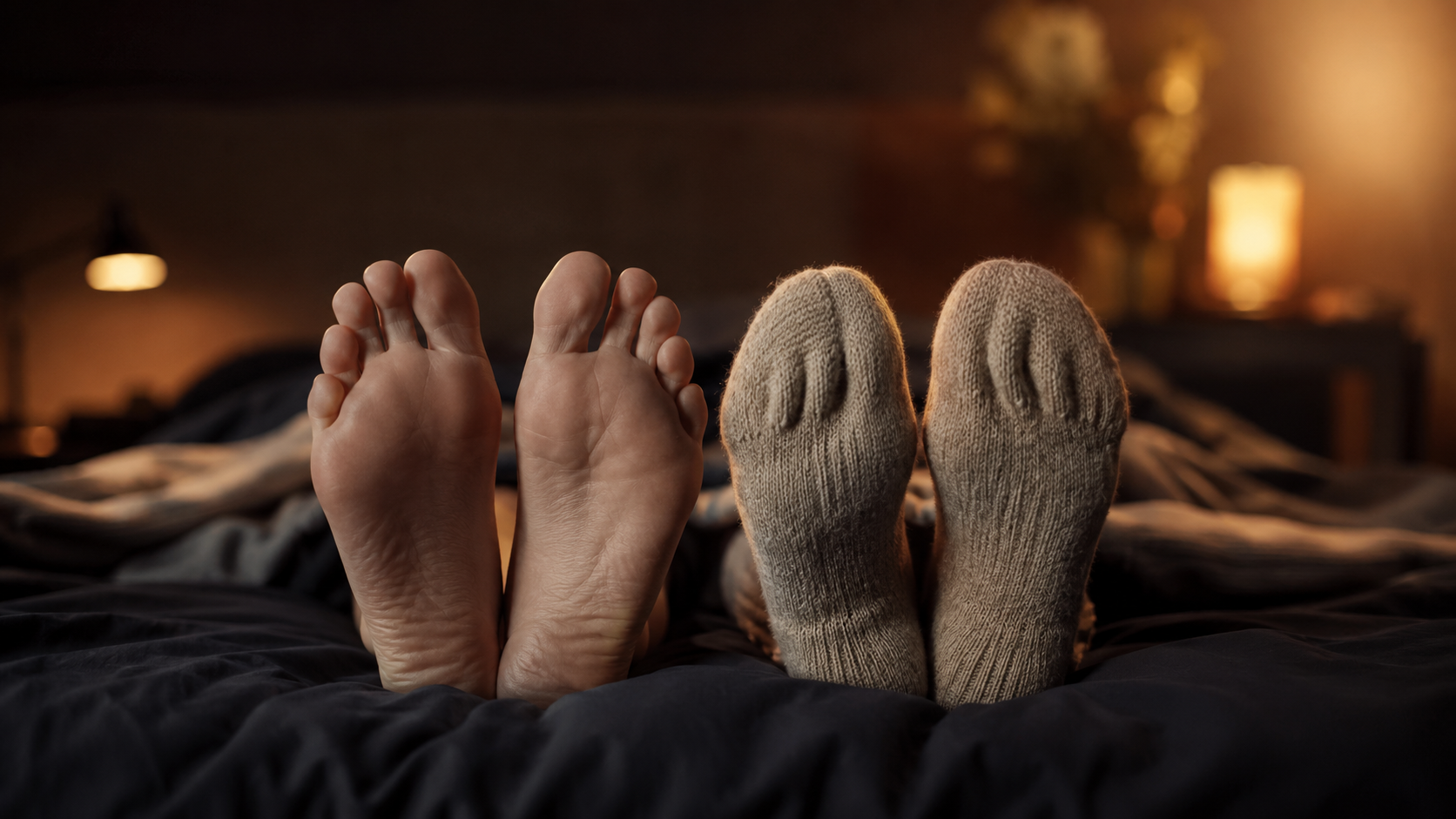
I will keep faith with you and not oversell it.
Gert Holstege, chairman of the centre for uroneurology there, has been clear that testing this was never the study's aim, the sample was tiny, and "wear socks, climax harder" is really folklore in a lab coat.
But look at why it happened, because that part is solid.
What the scans showed reliably is that orgasm requires the brain's fear and vigilance centres to go quiet. The amygdala, chief among them, strongly deactivates. You cannot be braced and aroused at the same time. Cold feet are a small, insistent signal of threat. They keep one hand on the alarm. Warm feet take it off.
Which is the Kidney Yang story told in a different accent. When the Ming Men fire is strong and moving freely, the body is willing. When cold pulls inward and Yang scatters to defend the surface, the body turns guarded instead of open. The autonomic nervous system and the classical medicine are describing the same event from two windows.
Wear the socks. It was never really about the socks.
When it is time to sleep?
🟢 Established Physiology · 🟠 Informed Synthesis
Sleep is essential for optimal recovery. Your socks, then, are performance-enhancing devices. Here's how.
In 1999 a Swiss research group published something in Nature that I found curious: the single best predictor of how quickly someone falls asleep wasn't what their brain was doing. It was what their feet were doing. Widening blood vessels in the feet mean warm feet, shedding heat. Cold feet do the opposite, telling the body to stay on watch.
As bedtime approaches, healthy blood vessels in the hands and feet begin to relax and widen. Physiologists call it distal vasodilation. Warm blood moves toward the skin, heat is released into the room, the body's core temperature falls by a degree or so, and the brain quietly receives one of its favourite messages:
Night has arrived. You can let go now.
Sleep is not simply something that happens to us. It is something the nervous system permits.
That permission depends on hundreds of tiny signals agreeing with one another. The light has faded. The room is safe. The breathing has slowed. The body has enough warmth to spare that it can afford to lose a little.
Cold feet interrupt that conversation.
If your feet remain cold, the small arteries stay constricted. Heat stays trapped in the body's core instead of being gently released. Core temperature falls more slowly, sleep onset is delayed, and the nervous system lingers in a state that is subtly more vigilant than restful.
One tiny piece of physiology. One surprisingly large consequence.
That matters because sleep is the master variable. Almost every system we care about is repaired, recalibrated or reorganised while we sleep. Hormones are balanced. Immune cells patrol. Memories are sorted. Emotional experiences are integrated. The brain literally clears metabolic waste through the glymphatic system.
Miss enough nights and almost everything becomes harder. Mood sinks. Pain thresholds fall. Food cravings rise. Concentration frays. Small problems begin to feel enormous.
Follow the chain honestly: cold feet delay sleep onset, a sleep debt builds, and chronic short sleep erodes mood, sharpens anxiety, and shortens every fuse.
There is almost no mental health condition that chronic sleep disruption doesn't worsen.
Which means a pair of cold feet is sometimes doing far more than making you uncomfortable.
And there is a piece of research your grandmother would have appreciated. Researchers at Cardiff's Common Cold Centre chilled the feet of ninety volunteers in cold water and left another ninety dry. More than twice as many of the chilled group came down with cold symptoms over the following days. The proposed mechanism was elegantly simple: cooling the feet reflexively narrowed blood vessels inside the nose, reducing local immune defence and giving viruses already loitering there a better opportunity to establish themselves.
Small study. Modest conclusions. The direction, though, is difficult to ignore.
"You'll catch your death" wasn't myth. It was observation. Our grandmothers rarely spoke about peripheral vasodilation or thermoregulation. They simply told us to put our slippers on.
Sometimes folk wisdom arrives generations before the physiology catches up.
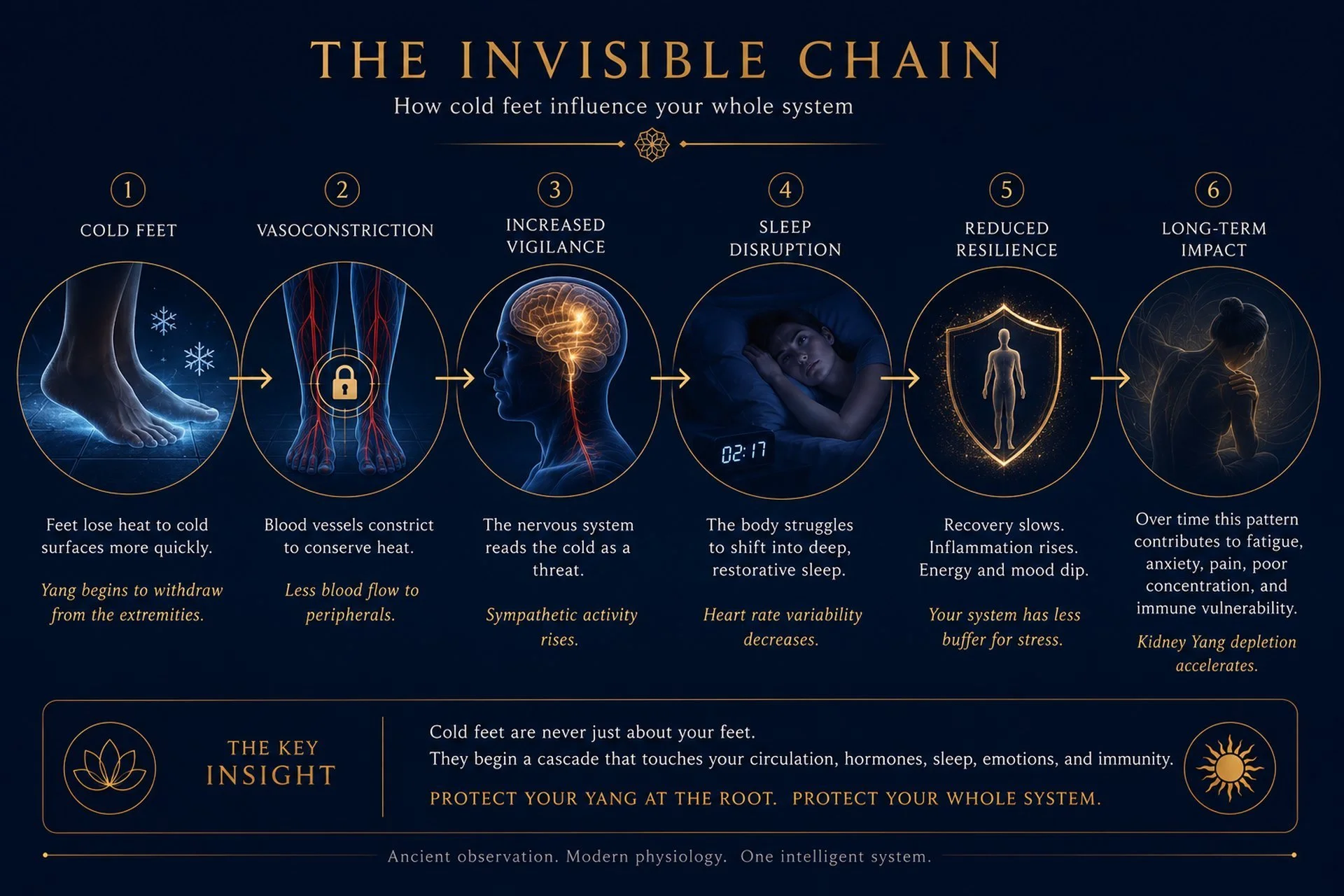
Cold feet are never just about your feet. They begin a cascade that touches circulation, sleep, mood and immunity.
The mind in the cold
🟠 Informed Synthesis · 🔵 Clinical Observation
Chronically cold feet may have more effect on mood, sleep, and mental clarity than most people expect. This is the part most likely to be waved away, and the part I most want to speak to, with emphasis.
In Chinese medicine the Blood is not merely a transport fluid. It is the residence of the Shen, the place the mind lives. A settled mind is one whose Blood is moving cleanly, because the Blood is what gives the spirit somewhere to rest.
Ask what happens when the Blood stops moving cleanly. When cold congeals it, exactly as we said at the start. The Shen loses its anchor. And a mind that has lost its anchor doesn't just feel low. It feels unmoored, foggy, oddly far from itself. Every medical tradition has had to answer the same question: where does the mind live? Chinese medicine answered differently from modern neuroscience. (LINK TO ‘WHERE IS IT?’ PIECE?) SHoRT where body feels anxiety
A nineteenth-century physician named Wang Qingren had the unusual habit of refusing to accept explanations that didn’t match what he saw with his own eyes. A genuine renegade, he performed dissections at a time when that took real nerve. He concluded that much of what his era called madness was, at root, 'stuck' Blood.
He built a formula for exactly this. Its name says everything: Drive Out Stasis from the Mansion of Blood (Xue Fu Zhu Yu Tang, 血府逐瘀湯)..
Get the blood moving. Watch the mind come home.
I'm not telling you a cold floor causes serious mental illness. I'm telling you the spectrum is longer than people assume. At the gentle end, cold feet cost you sleep and equanimity. Further along the same line, in a body already running short on warm, moving Blood, the mind itself can begin to feel as though it isn't seated properly inside you.
Mothers in the depleted months after birth sit nearer that end of the spectrum than most. Which is exactly why every traditional culture on earth circled the wagons around keeping them warm.
One final thread. A 2016 trial in JAMA Psychiatry found that a single session of whole-body heating produced an antidepressant effect lasting several weeks. The proposed mechanism: warmth activates pathways wired into the brain's serotonin circuitry.
That is clinical hyperthermia, not a pair of bed socks, and I won't pretend otherwise. But it points in the same direction. The body reads warmth as safety. Giving your warmth away through the soles of your feet, every cold morning, for years, is not a neutral act for the mind.
What To Actually Do
Wear the socks. Keep slippers where your feet land in the morning. Put a mat on the tile where you actually stand: the kitchen, the bathroom, the side of the bed. Warm your feet before sleep rather than carrying the day's chill into the night.
Keep your lower back and belly covered in the cold months. Doubly so around your period and after a birth.
If your feet are consistently cold, here are some hot tips:
Always
Slippers, ugg boots. Leave your slip-ons beside your bed where your feet hit the floor, so you never miss.
Wool socks (natural fibres are a win).
Mornings
Warm breakfast: add cinnamon (cardamom, cloves, pepper, ginger and other warming culinary herbs and spices are helpful additions).
Resistance exercise: don't skip leg day.
Daytime
Warm drinks (chai, for the warming effect).
Nothing cold or icy by mouth, nothing directly from the fridge. It is taxing on your inner yang to provide the balancing thermal energy.
Regular walking and movement: don't sit still for longer than an hour at a time.
Before bed
Reflexology and self-release of fascial tissue with a ball or stick.
Hot foot soak. It also moves the blood away from the head, and will help you sleep deeply.
And if your feet won't warm no matter what you do, if thick socks make no difference, stop buying thicker socks and look at your thyroid, insulin sensitivity, and iron. The body is telling you something before it has to shout.
Yang is rarely lost in one grand gesture. It leaks, a cold morning at a time.
Are we safe enough to open? Or should we stay guarded?
Sometimes the answer begins with philosophy. Sometimes it begins with the soles of your feet.
The kettle has boiled. Go and find your slippers.
If you recognise yourself in this, the cold that won't shift, the period pain, the flat afternoons, the sleep that doesn't restore, this is exactly the kind of pattern that responds well to acupuncture and Chinese medicine.
Book a private session with Steven Booth →
For practitioners and students wanting to go deeper: Seven Stars Lightworker Academy →
Steven Booth has been in clinical practice for over two decades. Trained as a transpersonal counsellor and one of a small number of practitioners worldwide working at the frontier of Esoteric Acupuncture, he uses precise geometric point sequences to activate the body's multi-dimensional energetic field. Drawing on ancient healing traditions and the emerging science of frequency medicine, his work supports expanded consciousness, deep integration and states of coherence that standard treatment rarely touches. He writes about Chinese medicine, consciousness and the body's quiet intelligence for practitioners and general audiences.
Notes and references
Kräuchi K et al. Warm feet promote the rapid onset of sleep. Nature. 1999. nature.com/articles/43366
Johnson C, Eccles R. Acute cooling of the feet and the onset of common cold symptoms. Family Practice. 2005. pubmed.ncbi.nlm.nih.gov/16286463
Janssen CW et al. Whole-body hyperthermia for the treatment of major depressive disorder. JAMA Psychiatry. 2016. jamanetwork.com/journals/jamapsychiatry/fullarticle/2521478
Kwon CY et al. Acupuncture for cold hypersensitivity in the hands and feet. PLOS ONE. 2024. doi.org/10.1371/journal.pone.0313789
Zhang Zhongjing. Shang Han Lun / Treatise on Cold Damage. Classical Chinese medical text, late Han dynasty tradition. shen-nong.com/eng/classics/shanghan/index.html
Wang Qingren. Yi Lin Gai Cuo / Corrections on the Errors of Medical Works. 1830. meandqi.com/knowledge-base/formulas/xue-fu-zhu-yu-tang
Thermal effusivity data: Engineering Toolbox (2025), ASHRAE Fundamentals.
© Steven Booth · The Steven Booth Journal · stevenboothacupuncture.com.au
Frequently Asked Questions
-
In Chinese medicine, the Kidney channel begins at the sole of the foot at a point called Yongquan, Bubbling Spring. This channel governs your constitutional reserves, your deepest warmth, and your vitality. Cold entering through the feet enters directly onto the channel that governs how much fuel you have to work with. Cold also congeals Blood and slows Qi, which over time produces the full range of consequences that follow from stagnation: aching, fatigue, cold limbs, poor sleep, and low drive. Persistently cold feet, cold even in summer, cold in bed, are worth investigating for thyroid function and iron levels as well.
-
Kidney Yang is the root warmth of the body in Chinese medicine, the constitutional fire that every other organ borrows from. When it runs low, through chronic cold, overwork, too little sleep, or long periods of depletion, the picture that emerges is cold hands and feet, low energy, a flat quality to the day, poor libido, and difficulty staying warm even in bed. It is usually a slow leak rather than a sudden collapse. It responds well to acupuncture, moxa, dietary changes, and consistent lifestyle adjustments.
-
Yes, cold feet can directly affect your period, and this is one of the clearest patterns in Chinese medicine. The three Yin channels of the leg all run through the lower abdomen and influence the uterus and pelvic blood flow. When cold settles in the lower burner, the result is often sharp cramping period pain, blood that arrives dark or clotted, cycles that come late, and marked relief from heat applied to the lower abdomen. This pattern responds well to treatment, but it requires warmth applied consistently, not just when the pain arrives.
-
Warm feet are the single best physiological predictor of how quickly a person falls asleep, a finding from a 1999 paper in Nature by Kräuchi and colleagues at the University of Basel. Cold feet signal threat to the nervous system, which stays alert rather than unwinding. In Chinese medicine, Kidney Yang and well-nourished Blood are both necessary for restful sleep. When either is depleted, sleep becomes light, restless, and unrepairing.
-
Ming Men, the Gate of Vitality, is the constitutional fire held between the Kidneys in classical Chinese medicine. It is considered the root of all warmth, drive, and reproductive vitality in the body, associated with acupuncture point GV4 at the second lumbar vertebra. Protecting the Ming Men means protecting warmth at the root through consistent everyday choices: staying warm, sleeping enough, not burning the candle at both ends year after year.
-
Chilling the feet leads to roughly twice the rate of cold symptoms, demonstrated in a 2005 study by Johnson and Eccles at Cardiff University's Common Cold Centre. They chilled the feet of ninety volunteers in cold water and left another ninety as controls. Roughly twice as many of the chilled group developed cold symptoms over the following days. Their proposed mechanism: chilling causes reflex constriction of blood vessels in the nose, cooling the mucosa and lowering its defences against viruses already present. Small study, modest conclusions, but consistent with what Chinese medicine has maintained for eighteen centuries.
-
Yes, both acupuncture and electroacupuncture significantly improve cold hypersensitivity in the hands and feet, with measurable improvements in both symptoms and skin temperature. This was demonstrated in a 2024 randomised controlled trial in PLOS ONE. In clinical practice, most patients with cold feet as part of a broader Kidney Yang deficiency pattern respond well to a course of treatment combined with lifestyle measures.
-
Yes. Private sessions at the Byron Bay clinic address the full range of patterns discussed here, including Kidney Yang deficiency, cold in the lower burner, and postpartum depletion. Sessions combine transpersonal acupuncture with esoteric acupuncture, working at both the physical and the deeper energetic level. Book a session here.